Wednesday, May 31, 2006
Calling the Blogosphere
The P-G's Bill Toland is wrestling with what to call Pittsburgh bloggers. The blurghosphere? burghosphere? yinzosphere? I'm following Bill's lead. These are his words, not mine. I'm not going to touch that last one, but I wonder about the need for a name in the first place. Isn't Pittsburgh parochial enough without naming and claiming its own corner of the blogosphere? Isn't the whole point of the Net *not* to think only in RL geographic terms? Come to think of it, I'm not even a big fan of "blogosphere." Enough with the new words to describe life with digital technology! No more new words until everyone can use "fangirl" in a sentence. As a verb.

R & D in Pittsburgh
A short time ago, Harold Miller blogged about the role of corporate R & D in growing Pittsburgh's economy.
I'm not so optimistic about local R & D spawning new companies here; in fact, some of the highest profile recent R & D moves to Pittsburgh -- Seagate, Intel, Apple, Google -- involve companies that are capitalizing on Pittsburgh's technical expertise (and Carnegie Mellon's expertise in particular) precisely to support corporate growth elsewhere. In fact, there's a case to be made that R & D thrives in Pittsburgh precisely *because* the parent operating companies *don't* live here. Corporate culture can be stifling. Move the idea generators out of the corporate hothouse, and better ideas come along.
Maybe the R & D business strategy for Pittsburgh is to attract corporate R & D for its own sake, not because it spins out other growth. I'm not angling for a new slogan for Pittsburgh, but "Where the Ideas Come From" isn't a bad one.
The Pittsburgh Region has the good fortune to have a significant base of corporate R&D facilities. PPG's Chemicals, Coatings, and Glass Research Centers are all located here. Alcoa's Technical Center - the largest light metals research facility in the world - is located here. Crucible Materials Corporation's Research Facility, with the largest titanium gas atomizer in the world, is located here. Bayer's Material Science division is located here. U.S. Steel's Research Center is located here. The Heinz Global Innovation and Quality Center is located here. Seagate's Research Center is located here. Mine Safety Appliances has its Research Center located here. Sunoco has a Research Center here. The list goes on and on.
Not only do these corporate R&D centers provide thousands of highly-paid jobs for the region, they hold the potential for creating new startup companies for the region. While many of the innovations developed in these R&D Centers will be utilized by their parent corporations to improve the cost or quality of existing products or to introduce new products consistent with the corporation's business strategy, other innovations may produce their greatest value through a new startup company. And those startup companies, if they are successful, will create more new jobs for their home region.
I'm not so optimistic about local R & D spawning new companies here; in fact, some of the highest profile recent R & D moves to Pittsburgh -- Seagate, Intel, Apple, Google -- involve companies that are capitalizing on Pittsburgh's technical expertise (and Carnegie Mellon's expertise in particular) precisely to support corporate growth elsewhere. In fact, there's a case to be made that R & D thrives in Pittsburgh precisely *because* the parent operating companies *don't* live here. Corporate culture can be stifling. Move the idea generators out of the corporate hothouse, and better ideas come along.
Maybe the R & D business strategy for Pittsburgh is to attract corporate R & D for its own sake, not because it spins out other growth. I'm not angling for a new slogan for Pittsburgh, but "Where the Ideas Come From" isn't a bad one.
Schenley Plaza
 The former parking lot in Oakland known as Schenley Plaza is set to have its grand re-opening on June 8, but the green space is already a big winner. And it's no harder for me to find parking on the street now than it was B.G. (before green).
How to Be Silicon Valley -- Part 2
More from Paul Graham: "Why Startups Condense in America"
So let's look at Silicon Valley the way you'd look at a product made by a competitor. What weaknesses could you exploit? How could you make something users would like better? The users in this case are those critical few thousand people you'd like to move to your silicon valley.
To start with, Silicon Valley is too far from San Francisco. Palo Alto, the original ground zero, is about thirty miles away, and the present center more like forty. So people who come to work in Silicon Valley face an unpleasant choice: either live in the boring sprawl of the valley proper, or live in San Francisco and endure an hour commute each way.
The best thing would be if the silicon valley were not merely closer to the interesting city, but interesting itself. And there is a lot of room for improvement here. Palo Alto is not so bad, but everything built since is the worst sort of strip development. You can measure how demoralizing it is by the number of people who will sacrifice two hours a day commuting rather than live there.
Another area in which you could easily surpass Silicon Valley is public transportation. There is a train running the length of it, and by American standards it's not bad. Which is to say that to Japanese or Europeans it would seem like something out of the third world.
The kind of people you want to attract to your silicon valley like to get around by train, bicyle, and on foot. So if you want to beat America, design a town that puts cars last. It will be a while before any American city can bring itself to do that.
Tuesday, May 30, 2006
The Great Tech North, eh.

How big is the tech workforce in Pittsburgh? The Canadians have an answer. Pittsburgh still counts in the top 30 North American regions, which our neighbors to the north like to use for benchmarking. Here is a useful report just out with some Pittsburgh data:
Innovation Capabilities: Comparing Science and Engineering Employment in US and Canadian Cities, by Desmond Beckstead and W. Mark Brown of Statistics Canada. (May 2006). What do they find? By their definition Pittsburgh has a Science and Engineering workforce of 47,224
Which incidentially makes you think.... While there are a lot of reasons to keep to a nation-specific focus in benchmarking, why don't we include Canadian regions in more comparisons. Pennsylvania does share a border with Canada (granted it's a waterborne border demarked out in the middle of Lake Erie) and Toronto is not much more of a drive than is Philadelphia.
Sunday, May 28, 2006
Harrisburg Inc.?
Hello Pittsblog! We spend a lot of time talking about local efforts and promoting innovation and entrepreneurship, but the elephant(s) in the china shop remains state governments across the US. Especially in terms of sheer financial resources, but also in terms of tax and other policy tools available: state government is always a player. How state governments interact in the venture capital world is surveyed in this report just released:
Seed and Venture Capital: State Experiences and Options, by the National Association of Seed and Venture Funds
According to the report, Pennsylvania had $585mil invested by institutional venture capitalists in 2005. That amount would rank it a seemingly respectable 8th among all states. However, it is only a small fraction of the $9.3 billion invested in California that year, and less than the $868mil in the much smaller Washington State. Institutional venture capital may be far more concentrated within the US than you realize. Two states California and Massachusetts accounted for an amazing 58% of all institutional venture capital invested in 2005.
Most of the report focuses on state programs (151 different programs in 44 states) that interact with the VC world. These programs include:
1. Direct investments by state agencies
2. State Investment in privately managed, geographically restricted funds
3. Investment in a portfolio of private seed and venture capital partnerships
4. Tax credit incentives for private direct investment
5. Tax credit incentives for private indirect fund investment
6. Mobilizing Angel Networks
7. Matchmaking Services
8. Culture Bending Initiatives
Getting governments, especially large state governments, to act as profit-seeking, risk-taking entrepreneurs is a difficult and almost contradictory goal. Governments are almost by very definition averse to the risk taking that culture that is at the heart of the VC world. The report acknowledges that there have been both successes and failures in state polices aimed at building VC. Because states have policy motivations that go beyond just pure profit making, these programs are almost always targeted on certain industries or on certain regions. That in itself makes state-induced venture capital a different creature than most private sector capital which is free to go wherever necessary to get the best returns.
Even a thorough report like this is really only a small peek into the VC world. VC funding is split between institutional VC funds and informal funding sources. As this report points out, informal venture capital is motivated more by the “three F’s” or “love capital”: the business’s founders, family and friends. If it is difficult to get states to act as large institutional venture capitalists, it may be nearly impossible to get states to behave as investors do in the informal capital market.
Seed and Venture Capital: State Experiences and Options, by the National Association of Seed and Venture Funds
According to the report, Pennsylvania had $585mil invested by institutional venture capitalists in 2005. That amount would rank it a seemingly respectable 8th among all states. However, it is only a small fraction of the $9.3 billion invested in California that year, and less than the $868mil in the much smaller Washington State. Institutional venture capital may be far more concentrated within the US than you realize. Two states California and Massachusetts accounted for an amazing 58% of all institutional venture capital invested in 2005.
Most of the report focuses on state programs (151 different programs in 44 states) that interact with the VC world. These programs include:
1. Direct investments by state agencies
2. State Investment in privately managed, geographically restricted funds
3. Investment in a portfolio of private seed and venture capital partnerships
4. Tax credit incentives for private direct investment
5. Tax credit incentives for private indirect fund investment
6. Mobilizing Angel Networks
7. Matchmaking Services
8. Culture Bending Initiatives
Getting governments, especially large state governments, to act as profit-seeking, risk-taking entrepreneurs is a difficult and almost contradictory goal. Governments are almost by very definition averse to the risk taking that culture that is at the heart of the VC world. The report acknowledges that there have been both successes and failures in state polices aimed at building VC. Because states have policy motivations that go beyond just pure profit making, these programs are almost always targeted on certain industries or on certain regions. That in itself makes state-induced venture capital a different creature than most private sector capital which is free to go wherever necessary to get the best returns.
Even a thorough report like this is really only a small peek into the VC world. VC funding is split between institutional VC funds and informal funding sources. As this report points out, informal venture capital is motivated more by the “three F’s” or “love capital”: the business’s founders, family and friends. If it is difficult to get states to act as large institutional venture capitalists, it may be nearly impossible to get states to behave as investors do in the informal capital market.
Friday, May 26, 2006
Chris Briem to Guest at Pittsblog
I'm delighted to announce that Chris Briem will be guest blogging here at Pittsblog. (I'm continuing on, too, but will be taking a break during part of the summer.) Chris is a colleague of mine at Pitt and is the man with the data about Pittsburgh's economy. He recently unveiled his own blog, but Chris assures me that he has a few things to share with the Pittsblog audience. Welcome, Chris!
Web 2.0 in Pittsburgh
A friend asked me recently:
Are there any Web 2.0 players in Pittsburgh, in either research or commercialization spaces, or both? "Web 2.0" is as broad as you want to make it.
Thanks for your thoughts.
Are there any Web 2.0 players in Pittsburgh, in either research or commercialization spaces, or both? "Web 2.0" is as broad as you want to make it.
Thanks for your thoughts.
Thursday, May 25, 2006
How to Be Silicon Valley
Jefferson Provost forwards a link to a recent talk by Paul Graham, "How to Be Silicon Valley". Paul makes some pointed comparisons between the Valley and Pittsburgh. An excerpt:
There's more, and Paul is both right and wrong in a lot of big ways. Some of his errors have to do with how he models the Silicon Valley. Doesn't anyone remember the role of the defense industry out there? Lockheed, Ford, and Westinghouse created and then unleashed a huge pool of engineering talent in the South Bay. The Shockley/Fairchild story that he repeats is only part of the nerd narrative. And eccentricity requires wealth -- he's right about that -- but it's not just investing wealth that matters; it's wealth across the spectrum. Rich people matter not because they can put money in new ventures; rich people matter because someone has to pay the taxes that support the towns where the nerds want to play. Read John Markoff's What the Doormouse Said, and Jeff Goodell's Sunnyvale to get a sense of the suburban wealth that subsidized the high tech revolution. What happened in Northern California is that a wealthy culture was willing to tolerate and subsidize eccentricity at low levels. Over time, that eccentricity built on itself, to the point that it overthrew both the cultural and economic establishment.
The lesson for Pittsburgh, then, isn't quite the one that Paul Graham draws. He's pretty skeptical about Pittsburgh's prospects, because he doesn't see the money. But Pittsburgh has plenty of wealth. It doesn't have investing wealth, necessarily (it has capital, but not enough risk capital). It does have enough economic wealth spread generally across the region that Pittsburgh is a comfortable place to live. There are a lot of nice suburbs here, and a lot of pleasant and even wealthy neighborhoods in the City of Pittsburgh. What that wealth doesn't do particularly well, though, is tolerate the cultural and economic eccentricity that urban and university communities inevitably produce. To turn a rhetorical phrase, on the whole, Pittsburgh's taxpaying and grant-giving wealthy aren't happy about subsidizing subversion. If you want to be skeptical about Pittsburgh, be skeptical that that culture will ever change. If you want to be optimistic, even if you don't want Pittsburgh to be another Silicon Valley, be optimistic that Pittsburgh will turn out to be willing to subsidize eccentricity, and willing to give that eccentricity some space to breathe.
Graham has promised Part Two shortly. Stay tuned.
I think you only need two kinds of people to create a technology hub: rich people and nerds. They're the limiting reagents in the reaction that produces startups, because they're the only ones present when startups get started. Everyone else will move.
Observation bears this out: within the US, towns have become startup hubs if and only if they have both rich people and nerds. Few startups happen in Miami, for example, because although it's full of rich people, it has few nerds. It's not the kind of place nerds like.
Whereas Pittsburgh has the opposite problem: plenty of nerds, but no rich people. The top US Computer Science departments are said to be MIT, Stanford, Berkeley, and Carnegie-Mellon. MIT yielded Route 128. Stanford and Berkeley yielded Silicon Valley. But Carnegie-Mellon? The record skips at that point. Lower down the list, the University of Washington yielded a high-tech community in Seattle, and the University of Texas at Austin yielded one in Austin. But what happened in Pittsburgh? And in Ithaca, home of Cornell, which is also high on the list?
I grew up in Pittsburgh and went to college at Cornell, so I can answer for both. The weather is terrible, particularly in winter, and there's no interesting old city to make up for it, as there is in Boston. Rich people don't want to live in Pittsburgh or Ithaca. So while there are plenty of hackers who could start startups, there's no one to invest in them.
There's more, and Paul is both right and wrong in a lot of big ways. Some of his errors have to do with how he models the Silicon Valley. Doesn't anyone remember the role of the defense industry out there? Lockheed, Ford, and Westinghouse created and then unleashed a huge pool of engineering talent in the South Bay. The Shockley/Fairchild story that he repeats is only part of the nerd narrative. And eccentricity requires wealth -- he's right about that -- but it's not just investing wealth that matters; it's wealth across the spectrum. Rich people matter not because they can put money in new ventures; rich people matter because someone has to pay the taxes that support the towns where the nerds want to play. Read John Markoff's What the Doormouse Said, and Jeff Goodell's Sunnyvale to get a sense of the suburban wealth that subsidized the high tech revolution. What happened in Northern California is that a wealthy culture was willing to tolerate and subsidize eccentricity at low levels. Over time, that eccentricity built on itself, to the point that it overthrew both the cultural and economic establishment.
The lesson for Pittsburgh, then, isn't quite the one that Paul Graham draws. He's pretty skeptical about Pittsburgh's prospects, because he doesn't see the money. But Pittsburgh has plenty of wealth. It doesn't have investing wealth, necessarily (it has capital, but not enough risk capital). It does have enough economic wealth spread generally across the region that Pittsburgh is a comfortable place to live. There are a lot of nice suburbs here, and a lot of pleasant and even wealthy neighborhoods in the City of Pittsburgh. What that wealth doesn't do particularly well, though, is tolerate the cultural and economic eccentricity that urban and university communities inevitably produce. To turn a rhetorical phrase, on the whole, Pittsburgh's taxpaying and grant-giving wealthy aren't happy about subsidizing subversion. If you want to be skeptical about Pittsburgh, be skeptical that that culture will ever change. If you want to be optimistic, even if you don't want Pittsburgh to be another Silicon Valley, be optimistic that Pittsburgh will turn out to be willing to subsidize eccentricity, and willing to give that eccentricity some space to breathe.
Graham has promised Part Two shortly. Stay tuned.
Wednesday, May 24, 2006
On the Form of the City
There were some very interesting and provocative discussions about Downtown development recently, hosted at The Conversation (and also here) and AntiRust in particular.
I don't have much to add to the posts and the comments, except this: In talking about the future of downtown Pittsburgh (does it have one? what is it? what should it be?), it may be important to distinguish between the urban theory that guides the conversation, on the one hand, and particular development plans (or "no-development" plans) on the table (particular stores, restaurants, buildings, architectural styles, etc.), on the other. Both are important, and they're related, but they represent different levels of the discussion.
A reading suggestion: Kevin Lynch, A Theory of Good City Form, republished in paper as Good City Form.
I don't have much to add to the posts and the comments, except this: In talking about the future of downtown Pittsburgh (does it have one? what is it? what should it be?), it may be important to distinguish between the urban theory that guides the conversation, on the one hand, and particular development plans (or "no-development" plans) on the table (particular stores, restaurants, buildings, architectural styles, etc.), on the other. Both are important, and they're related, but they represent different levels of the discussion.
A reading suggestion: Kevin Lynch, A Theory of Good City Form, republished in paper as Good City Form.
BriemBlog
Now that Chris Briem is blogging himself, will he stop sending me cool tips about Pittsburgh's economy? Chris is my best source for real Pittsburgh history, so I hope not.
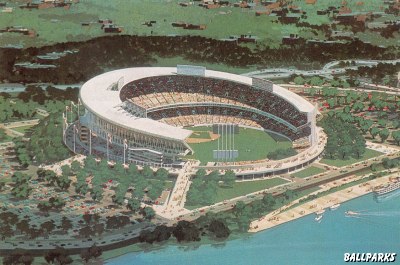
Also, if it weren't for Chris, I wouldn't have found this cool image: What Three Rivers Stadium might have looked like.

Also, if it weren't for Chris, I wouldn't have found this cool image: What Three Rivers Stadium might have looked like.
Reading the Intellectual Property Tea Leaves
Does the fact that Pittsburgh ranks at #8 on a list of American cities Googling "copyright law" mean anything at all?
Pittsburgh isn't in the top 10 for "patent law" or "trademark law".
It's number 8, again, for "internet law."
Pittsburgh isn't in the top 10 for "patent law" or "trademark law".
It's number 8, again, for "internet law."
Angel Funding
From the most recent Pop City to hit my inbox, what looks like a nice bit of success for Innovation Works and the startup technology community:
May 24, 2006
Over $1 million raised in 'angel' capital for local startups
Eight local technology startups raised more than $1 million in private investment since presenting their business plans at the first-ever Pittsburgh Angel Venture Fair in February. Companies had 90 days to raise a minimum of $100,000 to leverage an additional investment from Innovation Works (IW) of up to $50,000 each. The startups’ successful fundraising efforts motivated IW to increase its "challenge investment" from $250,000 to $400,000.
"These companies represent the exciting transformation occurring in and around the Pittsburgh area," says Matt Harbaugh, director of external finance at IW. The challenge was conceived as an incentive for entrepreneurs and investors to close a round of financing within a short time. "The fact that so many companies raised so much money is evidence of the increasing momentum of the region's early-stage technology economy," says Harbaugh.
Awarded companies are: Carnegie Speech Company, Inc., PetsDx, Inc., ChemDAQ Corp., Proteopure, Inc., FireFly Power Technologies, LLC, StageMark, Inc., Mid-Market America, Inc., and Thorley Industries.
Based on this success, IW now plans to hold its Angel Venture Fair and challenge investment annually. The company invests up to $600,000 yearly in startups, has four sister organizations statewide and is funded by the PA Department of Community Economic Development. "When a local company is launched, we like to be the first people they come to," adds Harbaugh.
So Long to Rolling Rock
 For more than a week, I've been out of town and offline for one reason or another. (Looks like I missed a helluva Blogfest!) Catching up on things, I discover -- suprise! -- that not much has changed, and what has changed seems to have changed for the worse:
The Post-Gazette proclaimed some reasons for optimism, looking both at changes in civic leadership and energy in the neighborhoods.
Hmmm. Look again: Millcraft Industries, the developer-du-jour for Downtown revitalization, is looking for a healthy public subsidy. The Mon-Fayette toll road is back in the news because several *billion* more state dollars are needed to finish it.
And -- the worst news of all -- Rolling Rock is leaving Latrobe. InBev, RR's corporate owner, is selling the brand to Anheuser-Busch. The hard working folks in Latrobe say that they're going to hold their breath until IB and AB change their minds.
The Rock looks like it's gone. But the brewery remains. I'm searching for a silver lining here. Maybe with an entrepreneurial link. Is there a Fritz Maytag waiting in the wings?
Thursday, May 11, 2006
Economic Development as a Zero-Sum Game
I heard the following story from an acquaintance at Tuesday's mashup. It may be apocryphal, but it has the ring of truth.
The lesson is a familiar one, and it's not just that it's hard for an outsider to break into the closed circle of business relationships that dominates Pittsburgh. The lesson is that if members of the Pittsburgh business community look at economic development as a zero-sum game -- if I give something to you, I lose something of my own -- then the region will continue to flounder economically. Growth requires giving without expecting an immediate return. Give, and you may get something back down the road; hoard, and you won't.
I don't care that people are selfish. In the business world, selfishness is often fine, even good. But "you're not in the book," or "I've got mine," aren't just manifestations of selfishness; they're manifestations of *feudal* selfishness. "Feudal* selfishness says "I am my own Lord, master of my domain." A growth-oriented economy depends on *market* selfishness. *Market* selfishness means my success depends on trading with you. And it assumes that development isn't a zero-sum game. If I trade with you, we can both make ourselves better off in the long run.
A native of Pittsburgh finished graduate school here and went off to New York to make his fortune. The fortune wasn't made, but solid career success arrived. With some money and a spouse, he returned home to start a family and continue his career. In fact, he was going to set the Pittsburgh business world on fire with his New York City acumen. He called a high school classmate, now a successful accountant in Pittsburgh, hoping to establish a networking relationship. The accountant said this: I have a book. It has two pages. On this page, I list people I owe. On the next page, I list people who owe me. You? You're not in the book.
The lesson is a familiar one, and it's not just that it's hard for an outsider to break into the closed circle of business relationships that dominates Pittsburgh. The lesson is that if members of the Pittsburgh business community look at economic development as a zero-sum game -- if I give something to you, I lose something of my own -- then the region will continue to flounder economically. Growth requires giving without expecting an immediate return. Give, and you may get something back down the road; hoard, and you won't.
I don't care that people are selfish. In the business world, selfishness is often fine, even good. But "you're not in the book," or "I've got mine," aren't just manifestations of selfishness; they're manifestations of *feudal* selfishness. "Feudal* selfishness says "I am my own Lord, master of my domain." A growth-oriented economy depends on *market* selfishness. *Market* selfishness means my success depends on trading with you. And it assumes that development isn't a zero-sum game. If I trade with you, we can both make ourselves better off in the long run.
Mash-Up Follow-Up
Last Tuesday's entrepreneurs "mash-up" was indeed a success, and congrats to Gary Rosensteel for pushing this inaugural version over the finish line. Some follow-up thoughts:
1. Relatively few of the "usual suspects" were at the event. I overheard some criticism on this point: No one from the investor community was there, apparently, and relatively few of the well-known heads of Pittsbugh's intermediary organizations. Personally, I took their absence as a good sign: there's a big demand out there for connectedness among people who are interested in the entrpreneurial economy, even working in it, and who need and want each other much more than they need or want help from above. Do this again and again, and keep expanding the pool. Also, venture capitalists don't go to this sort of thing, so don't be disappointed that they don't show up.
2. Because PUMP supplied volunteers, PUMP speakers pumped PUMP. Not good. This event wasn't about PUMP, and future events shouldn't be about PUMP. The point of the mash-up isn't to consolidate activity in one organization, or any handful of them. The point is to energize everyone to go out and do their thing, knowing that there is a network of like-minded people accessible to them.
3. The location and venue weren't great. In fact, they were downright dull. Can we get out of Downtown? Can we get out of an office tower? And the acoustics of the facility were so bad that it was difficult to hear the person next to you. Hearing any of the speakers at the microphone was just about impossible.
1. Relatively few of the "usual suspects" were at the event. I overheard some criticism on this point: No one from the investor community was there, apparently, and relatively few of the well-known heads of Pittsbugh's intermediary organizations. Personally, I took their absence as a good sign: there's a big demand out there for connectedness among people who are interested in the entrpreneurial economy, even working in it, and who need and want each other much more than they need or want help from above. Do this again and again, and keep expanding the pool. Also, venture capitalists don't go to this sort of thing, so don't be disappointed that they don't show up.
2. Because PUMP supplied volunteers, PUMP speakers pumped PUMP. Not good. This event wasn't about PUMP, and future events shouldn't be about PUMP. The point of the mash-up isn't to consolidate activity in one organization, or any handful of them. The point is to energize everyone to go out and do their thing, knowing that there is a network of like-minded people accessible to them.
3. The location and venue weren't great. In fact, they were downright dull. Can we get out of Downtown? Can we get out of an office tower? And the acoustics of the facility were so bad that it was difficult to hear the person next to you. Hearing any of the speakers at the microphone was just about impossible.
Wednesday, May 10, 2006
stlouisbusiness.net
Harold Miller is justifiably critical of city sloganeering, particularly since St. Louis has just come up with a real clunker. But St. Louis does have a nice new, welcoming website at http://www.stlouisbusiness.net/, and a brand new marketing campaign that's running in national media. If you go to http://www.pittsburghbusiness.net, well, you'll be disappointed.
Of course, St. Louis isn't one of Kiplinger's 10 "smartest places to live," but it does have a winning baseball team, Ted Drewes, and the Gateway Arch.
Of course, where did the steel for the arch come from . . . ?
Of course, St. Louis isn't one of Kiplinger's 10 "smartest places to live," but it does have a winning baseball team, Ted Drewes, and the Gateway Arch.
Of course, where did the steel for the arch come from . . . ?
Tuesday, May 09, 2006
Respironics About to Hit $1B
Jim points out that Respironics is about to become the first new technology company born in Pittsburgh, and still here, to reach $1 billion in annual sales. That's an amazing achievement. To see how amazing it is, take a look at this article from Fortune Small Business, and this sidebar.
JURIST Wins Webby
 JURIST, the legal website run by my colleague Bernard Hibbitts and hosted at the University of Pittsburgh School of Law, has won a "People's Voice" Webby award. Congrats to the JURIST team!
Monday, May 08, 2006
Gravity. Not Just a Good Idea . . .
Congrats to Pittsburgher Tom Buell, who won The New Yorker's recent Cartoon Caption contest:

“Back in my day, kids had a little respect for the law of gravity.”
(Drawing by Gahan Wilson )

“Back in my day, kids had a little respect for the law of gravity.”
(Drawing by Gahan Wilson )
Sunday, May 07, 2006
"Too Many" Again
Read all the way to the end of this feature on Heinz Endowments president Max King, and you find this gem:
Asked last week about where foundations can show more leadership, he mentioned economic development and diversity.
"This is not a community that is famous for its embrace of diversity and inclusion," he said. "I think that's an issue, both race and gender, for this community to pay more attention to."
Foundations, he said, also have to examine the issue of whether there are too many economic development groups, many of which survive on philanthropic support, or whether certain groups, such as the Allegheny Conference on Community Development, are working effectively with the money and resources available to them.
Friday, May 05, 2006
Report on the Innovation Works She-bang
I snagged an invitation to the Innovation Works celebration last evening (be careful, someone said; people will think you're part of The Establishment!), and I went and had a good time. I met some new people and reconnected with some people I already knew. I know that the Post-Gazette was there, and maybe other media, and I don't want to scoop anyone, but I do have a few observations. In no particular order:
1. Man, is this a small town or what? I've been networking pretty aggressively over the last nine months, and I've met a lot of people, but I kind of figured that what and who I know counts as the proverbial tip of the iceberg. There were undoubtedly a lot of movers and shakers missing from last night's crowd, but I knew a lot more people than I expected to. That iceberg isn't so big.
2. Lawrenceville is a happening neighborhood for high tech.
3. Innovation Works put on a very nice show. Both the organization and the staff made a persuasive case (through some companies that IW has worked with or is working with now) that IW is adding value to the region.
4. The local high tech economic development vibe is a positive one, partly because some interesting outsiders are eyeing what's happening here on the R&D side and thinking "Pittsburgh is a helluva business opportunity." Pittsburgh doesn't have the size or the resources to develop a Silicon Valley economy, but some of the economic forces that whip the Valley economy into high gear are blowing closer to Southwest PA. You could hear that in the cocktail party chatter, and you could hear it in the presentations. On balance, that's going to be a good thing for the local economy, but local service firms -- lawyers, investors, accountants, bankers, and so on, not to mention those who work for and with them -- need to take a leadership role or partner with others who will. If they don't, they risk getting pushed aside as leadership comes in from elsewhere.
5. Technology-based economic development is collaborative. We love to celebrate entrepreneurs, and the IW presentations last night were all about the one or two individuals who made this or that company happen. But the celebration of the individual is a bit of a mythology. Useful mythology, sometimes, but also sometimes harmful. None of these companies made a go of it without a lot of help, from a lot of people and a lot of institutions.
6. I didn't hear much last night about peer-to-peer counseling by startups. There was lots of talk about what great things IW has been doing; much less talk (really, no talk) about mechanisms for networking and support between groups of people who run new companies -- who are, let's assume, not competitors -- where the intermediary helps to establish the connection, then steps aside.
1. Man, is this a small town or what? I've been networking pretty aggressively over the last nine months, and I've met a lot of people, but I kind of figured that what and who I know counts as the proverbial tip of the iceberg. There were undoubtedly a lot of movers and shakers missing from last night's crowd, but I knew a lot more people than I expected to. That iceberg isn't so big.
2. Lawrenceville is a happening neighborhood for high tech.
3. Innovation Works put on a very nice show. Both the organization and the staff made a persuasive case (through some companies that IW has worked with or is working with now) that IW is adding value to the region.
4. The local high tech economic development vibe is a positive one, partly because some interesting outsiders are eyeing what's happening here on the R&D side and thinking "Pittsburgh is a helluva business opportunity." Pittsburgh doesn't have the size or the resources to develop a Silicon Valley economy, but some of the economic forces that whip the Valley economy into high gear are blowing closer to Southwest PA. You could hear that in the cocktail party chatter, and you could hear it in the presentations. On balance, that's going to be a good thing for the local economy, but local service firms -- lawyers, investors, accountants, bankers, and so on, not to mention those who work for and with them -- need to take a leadership role or partner with others who will. If they don't, they risk getting pushed aside as leadership comes in from elsewhere.
5. Technology-based economic development is collaborative. We love to celebrate entrepreneurs, and the IW presentations last night were all about the one or two individuals who made this or that company happen. But the celebration of the individual is a bit of a mythology. Useful mythology, sometimes, but also sometimes harmful. None of these companies made a go of it without a lot of help, from a lot of people and a lot of institutions.
6. I didn't hear much last night about peer-to-peer counseling by startups. There was lots of talk about what great things IW has been doing; much less talk (really, no talk) about mechanisms for networking and support between groups of people who run new companies -- who are, let's assume, not competitors -- where the intermediary helps to establish the connection, then steps aside.
A Chef Speaks
My "Too Many Chefs?" post attracted a long thread of comments, which included a lot of notes about the Pittsburgh Technology Council. The PTC responded, at the end of that thread, but it's a long thread, and I don't know how patient everyone is. Why not give the PTC its own platform? So here's the comment, reproduced in full.
Mike:
The conversation you sparked with your “Too Many Chefs?” query has turned into a lively and even impassioned one. But I fear that in the midst of all the passion, certain statements have been made about the Pittsburgh Technology Council that just have no basis in fact. Allow me to clear up some of the misperceptions.
First and foremost, the Pittsburgh Technology Council is not chartered as an economic development organization. It is a trade association, and as such, its mission is to provide the services that its member companies require to help them be successful. In addition, the services that the Council offers are not arbitrary or frivolous. They reflect the feedback and suggestions that are solicited from member companies on an almost constant basis. In fact the top two Council services that its members find most valuable include: 1.) advocacy and government relations and 2.) educational and informational events, programs and forums.
With respect to the first item above, over the last two years the Council successfully derailed $170 million in proposed new state and local taxes. The Council achieved this through aggressive public policy and lobbying efforts. It did this by engendering a more complete understanding among our key elected representatives of the difficulties imposed upon our region’s entrepreneurs by the stifling business climate. The Council’s efforts resulted in legislation that expanded the state’s R&D tax credit, reformed the state’s net operating loss provisions, retained the Delaware holding company provision and rolled back proposed new city taxes.
The second item above seems to run counter to an anonymous blogger’s assertion that the Council’s rigorous schedule of programs is a somehow a misplaced service. Why, then, would the Council continue to get high satisfaction ratings and high attendance (more than 13,000 for all of 2005) if this service was not deemed valuable. And someone please explain how using “attendee satisfaction” and “number of attendees” would not be the appropriate measure for a service that most member companies say they want or need.
There are several other services that a significant percentage of the Council’s members have indicated they find useful. And three out of four Council members are likely to recommend membership in the Council to other non-member companies.
In addition, it is imperative that I make clear that although the Pittsburgh Technology Council receives occasional grant awards for specific projects from both the state and federal government, this in no way should be construed as the Council’s only means of support, as was implied by another anonymous blogger. On a pie chart illustrating 2005 revenues for the Council, government grants do not even show up as a sliver.
Finally, the Pittsburgh Technology Council was erroneously characterized as being an umbrella for other organizations. In fact, the Council is a separate 501(c) 6 private non-profit trade association organized with a single mission to help technology companies succeed.
I would be glad to share how the Council does this at more length with anyone that contacts me directly at (412) 918-4247.
Kevin Lane
Pittsburgh Technology Council
Wednesday, May 03, 2006
Asian American Film Festival
 More on movies in Pittsburgh:
Coming soon: Silk Screen, the Asian-American Film Festival, beginning May 12.
Official film festival website.
Post-Gazette story
Business Times story
The festival organizers have a blog, at http://blog.silkscreenfestival.org/.
[Thanks, Venky!]
Pop City on Pgh Blogs
Today's Pop City has a feature on local blogs that includes links to lots of sites that I haven't seen before. The author, Jennifer Baron, blogs at Fresh Popcorn Productions and This Diary Belongs to. She also has a hand in the ultra-cool Pittsburgh Signs Project.
Tuesday, May 02, 2006
Hollywood on the Mon

This article about building an media and entertainment industry in Pittsburgh has some provocative suggestions -- but few concrete ideas for how to move them forward. There are four suggestions:
1. Pittsburgh needs facilities.
2. Put together a local incentive package.
3. Get local groups to work as a united front.
4. Get nontraditional businesses involved.
Can this happen? I hate to say this -- I really do, because I think that Pittsburgh offers a huge potential upside to motion picture and TV production companies, and having a visible and successful media and entertainment industry here would be fabulous -- but blah, blah, blah. Re-read those suggestions: They all put the responsibility somewhere else. Someone should provide facilities, put together incentives, get groups together, and so on. But who?
If today's local entertainment community is waiting for facilities, financial subsidies/incentives, multi-lateral cooperation, and interest from the industrial and manufacturing trades in a "new economy" proposition, then it's going to wait a while.
Instead, the local entertainment community can turn the question around and accept the responsibility. How can that community seize the initiative and leverage regional resources to build a local industry?
1. Seize the day, in a public way. Collaboration and cooperation is a great thing, but someone or something needs to energize the movement. Is the Pittsburgh Film Office going to lead the charge? If so, great. Get visible. How about a blog? How about communicating through non-traditional means? (Hey -- I teach copyright law. Can I help?) There are always some delicate politics involved, but it has to be possible to create a public presence without ruffling the wrong feathers.
2. If you want facilities, you'll have to build them yourselves. There are hungry and innovative real estate developers in Pittsburgh. Find them and work with them.
3. Partner with local organizations that work with the entrepreneurial community. If entertainment is a growth proposition, then get with the people who are into economic growth. If entertainment is a jobs proposition, they'll listen to you. They know the subsidy/incentives game, and they have some money.
4. Partner with the universities. CMU's Entertainment Technology Center, which gets a great plug in the P-G, is a world-leading organization. (It also happens to be right next door to Innovation Works.) And CMU has, hmmm (warning: irony alert!), a few faculty and a few alums who know something about the entertainment business.
But most of all, as with any other new value proposition in Pittsburgh, the entertainment industry can't wait for the world to improve around it. It has to push to make it happen on its own.
Monday, May 01, 2006
Corporate Entrepreneurship
So much energy goes into talking about startup entrepreneurship that too little energy, perhaps, goes into talking about entrepreneurship by established companies. Harold Miller's post today opens the door to this conversation: "Austin's experience with IBM is one more example of the importance of retaining the many existing corporate R&D centers in southwestern Pennsylvania, attracting new ones, and building strong bridges between the corporate R&D centers and our research universities and medical center."
That last point, which I've highlighted in bold, is the key one. The general question is how a region like Pittsburgh can leverage its two bases of extraordinary research resources. That usually gets translated into "how can universities do a better job of commercializing the useful research that lives in their labs?" (and sometimes into "how can we support our local base of pioneering entrepreneurs?"). But it's important to ask the established for-profit community the same question: How does an economy motivate its large existing companies -- the PPGs, the Bayers, the Alcoas, and so on -- to behave more entrepreneurially not only with respect to their own R&D, but also with respect to R&D that isn't home grown?
Harold and I have talked about the problem of corporate/university cooperation. As a first cut, we agree: this is both terribly important, and terribly difficult. If it's hard to nurture an entrepreneurial culture among individuals, think how hard it is to nurture a new entrepreneurial culture in an established enterprise. This isn't just a Pittsburgh problem, of course, though Pittsburgh has some particularly painful experience with the failure of established companies to sustain an entrepreurial model. But it's an issue that regional leaders should bear in mind even while time and public energy gets devoted to finding and funding the next great thing.
That last point, which I've highlighted in bold, is the key one. The general question is how a region like Pittsburgh can leverage its two bases of extraordinary research resources. That usually gets translated into "how can universities do a better job of commercializing the useful research that lives in their labs?" (and sometimes into "how can we support our local base of pioneering entrepreneurs?"). But it's important to ask the established for-profit community the same question: How does an economy motivate its large existing companies -- the PPGs, the Bayers, the Alcoas, and so on -- to behave more entrepreneurially not only with respect to their own R&D, but also with respect to R&D that isn't home grown?
Harold and I have talked about the problem of corporate/university cooperation. As a first cut, we agree: this is both terribly important, and terribly difficult. If it's hard to nurture an entrepreneurial culture among individuals, think how hard it is to nurture a new entrepreneurial culture in an established enterprise. This isn't just a Pittsburgh problem, of course, though Pittsburgh has some particularly painful experience with the failure of established companies to sustain an entrepreurial model. But it's an issue that regional leaders should bear in mind even while time and public energy gets devoted to finding and funding the next great thing.
Subscribe to:
Posts (Atom)