Thanks to Natalia at IHeartPgh for the pointer to LiveCreature.com, a blog about arts in Pittsburgh, "nibbling at the corners of Pittsburgh culture."
Natalia, by the way, just posted about Big Jim's, in a neighborhood that I discovered for the first time yesterday. Headed toward the Squirrel Hill tunnels on the Parkway, I've noticed the soccer field down in Panther Hollow. I was on that field yesterday, for the first time. Unlike the users of the Eliza Furnace Trail, I didn't know that there is a nice playground and basketball court directly under the Parkway, or that Big Jim's is the landmark that everyone uses to guide people to and through the neighborhood. I hope that all this publicity doesn't spoil the place.

Sunday, April 30, 2006

Friday, April 28, 2006
Mt. Lebanon in the News
Since I live in Mt. Lebanon, some Pittsblog readers have wondered why I haven't written about the issue that has Lebo in the news this week. I have, but not on Pittsblog. If you want to read what I have to say about "The List," go over to BlogLebo. Today's post. Wednesday's post.
I will repeat here one piece of today's post, because it dovetails with something that leaders throughout the region should take to heart:
Among the many problems here is a failure of leadership -- not only a failure of [Mt. Lebanon School] District leaders to respond swiftly to an obvious crisis situation, but a failure of those leaders to anticipate that this could happen. Read through this recent summary of the best known and most widely-studied recent episode in successful crisis management -- Johnson & Johnson's response to the Tylenol poisonings of 20+ years ago -- and watch for echoes of what MtLSD could and should have done, and should do, differently.
Effective leaders anticipate and plan, and when the worst happens, they're immediately in control of the situation. "The List" came to light in Mt. Lebanon almost three weeks ago. When it was brought to the attention of school administrators, an effective immediate response could have kept it out of the Post-Gazette, out of the Tribune-Review, out of the hands of the police, and the courts, and out of what may become the national spotlight.
I will repeat here one piece of today's post, because it dovetails with something that leaders throughout the region should take to heart:
Among the many problems here is a failure of leadership -- not only a failure of [Mt. Lebanon School] District leaders to respond swiftly to an obvious crisis situation, but a failure of those leaders to anticipate that this could happen. Read through this recent summary of the best known and most widely-studied recent episode in successful crisis management -- Johnson & Johnson's response to the Tylenol poisonings of 20+ years ago -- and watch for echoes of what MtLSD could and should have done, and should do, differently.
Effective leaders anticipate and plan, and when the worst happens, they're immediately in control of the situation. "The List" came to light in Mt. Lebanon almost three weeks ago. When it was brought to the attention of school administrators, an effective immediate response could have kept it out of the Post-Gazette, out of the Tribune-Review, out of the hands of the police, and the courts, and out of what may become the national spotlight.
Wednesday, April 26, 2006
Entrepreneurship Events -- May
 Upcoming in May, two events of note for local entrepreneurs and the technology community:
First, the long-planned entrepreneurs "mash-up" sponsored by PUMP, IW, HELP, and a bunch of other groups will finally happen on Tuesday, May 9, starting at 6 pm and going to whenever. The place: Heinz 57 Conference Center, Stanwix & Sixth Street, Downtown. It's free, and "refreshments" are provided, but registration is requested via www.pump.org/eventReg.jsp. If you'd like a full-size version of the flyer in the image, let me know by email. (And yes, I'll be there.)
Second, Innovation Works is having a party for itself and its partners, in Lawerenceville, on Thursday evening,
More East Liberty / Eastside
Chris forwards a link to a report on East Liberty [pdf] produced by UCSUR -- Pitt's University Center for Social and Urban Research -- in 1983. It offers an interesting historical perspective on current gentrification in East Liberty and the earlier conversation about whether any part of the area could or should be renamed "Eastside."
Tuesday, April 25, 2006
Arts Blog for Pittsburgh?
Is there a blog in town that does nothing but cover the local/regional arts scene? If so, Lee sends a link: Open Stage Theatre. Surely, though, this is just the tip of a very large iceberg. If there isn't a blog already, there should be. Call it "Steel City Arts," and do nothing but review and promote local performing and visual arts and artists.
Monday, April 24, 2006
Economic Development Strategy
I've been remiss in my blog reading. Check out Harold Miller's excellent post from April 13, on ED Strategy for the region:
Just like an investment portfolio should be diversified, the region’s economic development strategy needs multiple components. We should encourage businesses from other regions to locate here. We should assist our existing businesses to grow. And we should facilitate entrepreneurs to commercialize new technologies and services here. In the long run, the last of these three likely will have the biggest impact, just as it did at the beginning of the last century.
You can’t create jobs without companies, and most of the jobs that are here today were created by companies that started here. So creating companies should be as important a goal for the region as creating jobs.
And you can’t create companies without ideas, which is why maintaining and expanding the region’s research & development capacity is so important.
Asian Incubator
I've been catching up with the Post-Gazette online, so I don't know how prominently this story was played. I didn't notice any reference in the Business Times. Did it slip in under the radar? It looks pretty interesting to me:
[Thanks to Lee for the tip.]
[Aha. Pop City had a story on this earlier, though the coverage was from the real estate angle, not the incubator angle.
The Pittsburgh Planning Commission yesterday approved a proposal to build a nine-story, metal and glass building with an Asian design flavor at the SouthSide Works.
Specifically, the commission had to allow the building to be taller than 75 feet, because the zoning for SouthSide Works restricts all but three buildings to that height.
The proposed Surety Center would be 100 feet tall. The developer, Surety Pittsburgh, and Pfaffman and Associates architects are tailoring the building, in part, as an incubator for Asian businesses.
[Thanks to Lee for the tip.]
[Aha. Pop City had a story on this earlier, though the coverage was from the real estate angle, not the incubator angle.
Pittsburgh Neighborhood Tours
It's a very pretty site, this Pittsburgh Neighborhood Tours. But how many "come visit the pleasant place that is Pittsburgh" websites can the community sustain?
Lawrenceville Development
The P-G's Patricia Lowry has a nice story today on redevelopment efforts in Lawrenceville.
Wednesday, April 19, 2006
Too Many Chefs?
Here is an age-old question: Does Pittsburgh have too many organizations sponsoring and supporting technology-oriented entrepreneurship?
Before trying to answer that question, I want to inventory the resources. Here's a first cut. I'm sure that I'm missing important elements, so in a later post I'll try to flesh this out with the organizations that I haven't included here. Feel free to amend my list in the Comments.
Some of these are new, some are old. Some provide services, some provide money, some provide information, and some are technology-focused. Some are academic and teaching-oriented. Some are product-oriented. Some are company-oriented; some are jobs-oriented. Not all of them are focused on the tech sector specifically; not all of them are oriented specifically toward entrepreneurship. Many involve some "economic development" combination.
I'm *not* suggesting that all of these organizations provide the same or even similar services. Nor am I making any statements about what connections exist between or among them, or what connections should exist. That may come later. I know that there's a lot of history at work here. But for a small city, there sure are a lot of these things.
Innovation Works
Pittsburgh Technology Council
Idea Foundry
Pitt's Institute for Entrepreneurial Excellence
PantherLabWorks at IEE
Life Sciences Greenhouse
Technology Collaborative
SCORE
Small Business Development Center at IEE
HELP
E-Lifelines
Pittsburgh's Future
Pitt/CMU University Partnership
Don Jones Center for Entrepreneurship at CMU
Center for Biotechnology at Duquesne
Tissue Engineering Initiative
Pittsburgh Gateways
Swanson Institute for Technical Excellence at Pitt
Pennsylvania NanoMaterials Commercialization Center
Urban Redevelopment Authority of Pittsburgh (URA)
Technology Commercialization Alliance
Allegheny County Department of Economic Development
Office of Enterprise Development at Pitt
Center for Women's Entrepreneurship at Chatham
Small Business Development Center at Pitt
Small Business Development Center at Duquesne
Small Business Administration in Pittsburgh
I haven't started to catalog the service sector -- the lawyers (there are a few in Pittsburgh who work in this area, and the number is growing), the investors (VCs such as Birchmere; angel investors such as Blue Tree; blended outfits like Renaissance Partners), and the independent not-for-profits (foundations with an interest in entrepreneurship, such as Heinz, and investors with a different model, such as the Sprout Fund).
Before trying to answer that question, I want to inventory the resources. Here's a first cut. I'm sure that I'm missing important elements, so in a later post I'll try to flesh this out with the organizations that I haven't included here. Feel free to amend my list in the Comments.
Some of these are new, some are old. Some provide services, some provide money, some provide information, and some are technology-focused. Some are academic and teaching-oriented. Some are product-oriented. Some are company-oriented; some are jobs-oriented. Not all of them are focused on the tech sector specifically; not all of them are oriented specifically toward entrepreneurship. Many involve some "economic development" combination.
I'm *not* suggesting that all of these organizations provide the same or even similar services. Nor am I making any statements about what connections exist between or among them, or what connections should exist. That may come later. I know that there's a lot of history at work here. But for a small city, there sure are a lot of these things.
Innovation Works
Pittsburgh Technology Council
Idea Foundry
Pitt's Institute for Entrepreneurial Excellence
PantherLabWorks at IEE
Life Sciences Greenhouse
Technology Collaborative
SCORE
Small Business Development Center at IEE
HELP
E-Lifelines
Pittsburgh's Future
Pitt/CMU University Partnership
Don Jones Center for Entrepreneurship at CMU
Center for Biotechnology at Duquesne
Tissue Engineering Initiative
Pittsburgh Gateways
Swanson Institute for Technical Excellence at Pitt
Pennsylvania NanoMaterials Commercialization Center
Urban Redevelopment Authority of Pittsburgh (URA)
Technology Commercialization Alliance
Allegheny County Department of Economic Development
Office of Enterprise Development at Pitt
Center for Women's Entrepreneurship at Chatham
Small Business Development Center at Pitt
Small Business Development Center at Duquesne
Small Business Administration in Pittsburgh
I haven't started to catalog the service sector -- the lawyers (there are a few in Pittsburgh who work in this area, and the number is growing), the investors (VCs such as Birchmere; angel investors such as Blue Tree; blended outfits like Renaissance Partners), and the independent not-for-profits (foundations with an interest in entrepreneurship, such as Heinz, and investors with a different model, such as the Sprout Fund).
Sunday, April 16, 2006
Casino Journal
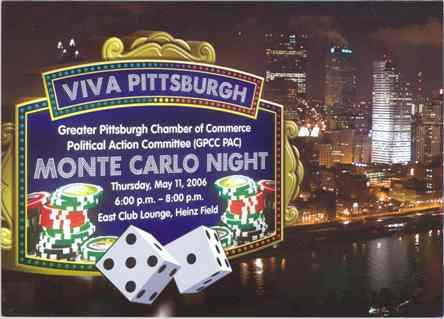 The Post-Gazette is dipping its toes into the blogosphere. Come on in, the water's fine! (How's that for mixing metaphors?) Welcome to Bill Toland's Casino Journal.
 Photo via Chris B., who shot it at a conference recently. Timely, eh? For branding mavens out there, a new slogan emerges. Pittsburgh: Monte Carlo on the Mon. (The Commenters should have a field day with this. Have fun!)
Proud Pittsburgh
Welcome to the blogosphere to Proud Pittsburgh, a blog run by a local architect convinced that Renaissance III is underway in Pittsburgh and determined to share the good news with the rest of the world.
Nice photos and graphics.
Nice photos and graphics.
Friday, April 14, 2006
Eastside?
Is "East Liberty" on its way to becoming "Eastside"?
"Eastside" is the name of a real estate development.
"East Liberty" is the name of a Pittsburgh neighborhood, and East Liberty Development Inc. is an organization that is working to revitalize it.
I now sometimes hear my students, many of whom live in North Oakland, and Squirrel Hill, and Shadyside, refer to the neighborhood as "Eastside." They also report hearing "Eastside" as a neighborhood descriptor on local radio.
I may come across sometimes as a critic of efforts to hold onto the past without reason. I'm also a pretty regular skeptic of efforts to "brand" Pittsburgh with slogans. Here, where both premises seem to come into play, the second strikes me as being more powerful than the first. The conflation of "Eastside" (the real estate) and "East Liberty" (the place) seems like a bad thing.
Questions: Does East Liberty need a "reverse" branding initiative so that it remains, proudly, "East Liberty"? Or does the apparent naming confusion follow from a deliberate effort to distance the current neighborhood from what some might think are the negative associations of the past (and to associate the neighborhood with the more upscale Shadyside)? On the one hand, my relative lack of local historical knowledge means that I don't carry around any negative associations for East Liberty. On the other hand, why should I? Is this even worth caring about?
And before someone else says it, I will: North Shore, or what used to be the North Side?
"Eastside" is the name of a real estate development.
"East Liberty" is the name of a Pittsburgh neighborhood, and East Liberty Development Inc. is an organization that is working to revitalize it.
I now sometimes hear my students, many of whom live in North Oakland, and Squirrel Hill, and Shadyside, refer to the neighborhood as "Eastside." They also report hearing "Eastside" as a neighborhood descriptor on local radio.
I may come across sometimes as a critic of efforts to hold onto the past without reason. I'm also a pretty regular skeptic of efforts to "brand" Pittsburgh with slogans. Here, where both premises seem to come into play, the second strikes me as being more powerful than the first. The conflation of "Eastside" (the real estate) and "East Liberty" (the place) seems like a bad thing.
Questions: Does East Liberty need a "reverse" branding initiative so that it remains, proudly, "East Liberty"? Or does the apparent naming confusion follow from a deliberate effort to distance the current neighborhood from what some might think are the negative associations of the past (and to associate the neighborhood with the more upscale Shadyside)? On the one hand, my relative lack of local historical knowledge means that I don't carry around any negative associations for East Liberty. On the other hand, why should I? Is this even worth caring about?
And before someone else says it, I will: North Shore, or what used to be the North Side?
Thursday, April 13, 2006
Local Law Site Nominated for Webby
Jurist, a legal news and information web portal operated by my Pitt Law colleague Bernie Hibbitts, has been nominated for a Webby Award as the best law website of 2006.
Part of the selection process is VOTING by SURFERS like you and me. If you think that Jurist deserves a Webby, go to the voting site at http://peoplesvoice.webbyawards.com/register.mhtml, register to vote, and vote!
(In my best Bartles & Jaymes voice) Professor Hibbitts and the University of Pittsburgh School of Law thank you for your support.
Winners will be announced on May 9.
Part of the selection process is VOTING by SURFERS like you and me. If you think that Jurist deserves a Webby, go to the voting site at http://peoplesvoice.webbyawards.com/register.mhtml, register to vote, and vote!
(In my best Bartles & Jaymes voice) Professor Hibbitts and the University of Pittsburgh School of Law thank you for your support.
Winners will be announced on May 9.
Wednesday, April 12, 2006
Entrepreneurship Re-Cap
Since I posted a note and an op-ed last November about Pittsburgh high tech entrepreneurship, I've had a lot of meetings and conversations with people who are directly involved with the marketplace. I want to record a few observations, that is, things that I've heard a lot and from a wide variety of people. Some of them prompt some questions. Here's an initial list. I'll save a few for a later post.
1. "Pittsburgh has a "too many cooks" problem when it comes to tech strategy." I heard from a number of people that personal history gets in the way of forward economic progress in Pittsburgh. There are egos, and historical associations and present commitments, that are obstacles to success. I'm not sold on this idea. Can you name an economically vibrant urban area that isn't filled with big egos and complicated histories? I wonder whether the "too many cooks" concern is an excuse more than a real obstacle.
2. "Pittsburgh suffers either from too many strategic visions of success, or too few." I'm not sold on the idea that the region needs an integrated strategy, partly because I have a hard time imagining what it might be, and partly because I have a hard time imagining that some relevant group of people could agree on it. I do think, though, that everyone in this space needs to be able to use the same vocabulary. My own preferred starting point for that vocabulary is the vocabulary of risk. Who can take it, who should take it, who has taken it, and when.
3. "Pittsburgh doesn't think broadly enough." Whether Pittsburgh really does or not is hard to say, but I do agree with the assessment that Pittsburgh -- and by "Pittsburgh" I refer to investors, entrepreneurs, university resources, and members of service industries -- should be assessing tech strategy/ies and particular industries, markets, and investment opportunities in global terms, not just in regional or even national terms. One local firm put it to me this way: The difference between a Pittsburgh-area venture capitalist and a Silicon Valley venture capitalist is that a Silicon Valley VC instinctively and immediately looks at a new business proposition in terms of global markets. A Pittsburgh VC looks at a deal in terms of its regional potential. I don't know if that's right, but that's what I heard.
4. "Pittsburgh has plenty of early-stage private capital -- which isn't in the market right now." This a big argument in favor of continued public funding of early-stage investment. The private market got scared off after the bubble years (that sounds very plausible), so without public support, there wouldn't be nearly enough early-stage money locally (also very plausible). Even if this is true, though, I tend to think that investors and those who work with them need to work on strategies for bringing private early-stage money back to the market, and keeping it in the market. It's a bad idea to make public funding an important permanent feature of innovation policy. See "risk," above.
1. "Pittsburgh has a "too many cooks" problem when it comes to tech strategy." I heard from a number of people that personal history gets in the way of forward economic progress in Pittsburgh. There are egos, and historical associations and present commitments, that are obstacles to success. I'm not sold on this idea. Can you name an economically vibrant urban area that isn't filled with big egos and complicated histories? I wonder whether the "too many cooks" concern is an excuse more than a real obstacle.
2. "Pittsburgh suffers either from too many strategic visions of success, or too few." I'm not sold on the idea that the region needs an integrated strategy, partly because I have a hard time imagining what it might be, and partly because I have a hard time imagining that some relevant group of people could agree on it. I do think, though, that everyone in this space needs to be able to use the same vocabulary. My own preferred starting point for that vocabulary is the vocabulary of risk. Who can take it, who should take it, who has taken it, and when.
3. "Pittsburgh doesn't think broadly enough." Whether Pittsburgh really does or not is hard to say, but I do agree with the assessment that Pittsburgh -- and by "Pittsburgh" I refer to investors, entrepreneurs, university resources, and members of service industries -- should be assessing tech strategy/ies and particular industries, markets, and investment opportunities in global terms, not just in regional or even national terms. One local firm put it to me this way: The difference between a Pittsburgh-area venture capitalist and a Silicon Valley venture capitalist is that a Silicon Valley VC instinctively and immediately looks at a new business proposition in terms of global markets. A Pittsburgh VC looks at a deal in terms of its regional potential. I don't know if that's right, but that's what I heard.
4. "Pittsburgh has plenty of early-stage private capital -- which isn't in the market right now." This a big argument in favor of continued public funding of early-stage investment. The private market got scared off after the bubble years (that sounds very plausible), so without public support, there wouldn't be nearly enough early-stage money locally (also very plausible). Even if this is true, though, I tend to think that investors and those who work with them need to work on strategies for bringing private early-stage money back to the market, and keeping it in the market. It's a bad idea to make public funding an important permanent feature of innovation policy. See "risk," above.
"Pittsburghs News"
There's a new Pittsburgh blog-aggregator in town: http://pittsburghsnews.com, which appears to be part of a cluster of similar urban blog aggregators elsewhere in the US. The proprietors of the service are picking up local site feeds on an ad hoc basis. So far, for example, Pittsblog isn't part of the plan.
The question is whether this sort of activity is kosher (an appropriate phrasing, given that Passover starts tonight!). The answer, I think, is that no one is completely sure.
Before getting to the legal question, consider the pro's and con's. To start with, Pittsburgh News isn't and doesn't plan to be just an aggregator. The site will serve ads. That means that Pittsburgh News may derive ad revenue from visits to content that the blogger created. If the home blog also serves ads, that means that Pittsburgh News is competing for the ad revenue that the blogger might otherwise keep. And perhaps worst of all, if the home blog is part of a marketing strategy (a small business that blogs, for example), grabbing the feed and making it available through an aggregator may defeat the marketing point, since the content isn't surrounded by the rest of the content at the home site.
On the other hand, if a blogger makes a site feed available, presumably the blogger intends that other people will pick up that feed and read the blog via the feed, rather than by visiting the blog. If you don't want aggregators to pick up your stuff, it's easy enough to disable the feed. Moreover, a lot of people who don't include ads or use their blogs for business might welcome the additional readership for the content.
If a blogger objects to the aggregator picking up the feed, and if the aggregator goes ahead anyway, what does the law say? Not surprisingly, the answer is: not much. The aggregator faces both potential copyright problems and potential trademark problems. A handful of somewhat older cases dealt with "framing" and linking to website content. For the most part, merely linking to content is now regarded as acceptable. "Framing" is a legal problem if the framing site suggests sponsorship by or affiliation with the originating site. (The new "Perfect 10" suit against Google has the potential to make framing a bigger legal problem for aggregators.) Google has won a couple of recent lower court decisions involving Google's cache, which raises related issues. If you voluntarily put content on the web, you can't be surprised or harmed by the fact that Google stores it in its cache. Some technical resources may be useful as legal points: An exclusion header (robots.txt file) is both technically effective, up to a point, and legally effective, in that knowingly bypassing a robots.txt header may trigger liability for unauthorized access to a site or server. If you disable your site feed, in all likelihood it's not acceptable for someone else to create one for you without your permission.
In the blogosphere, however, I'm not aware of any litigation over the "unauthorized use of a site feed." Some time back, a tiff erupted over the request by Marty Schwimmer, a blogging trademark lawyer, that Bloglines stop carrying Marty's site feed. Marty objected to Bloglines' plan to sell ads, which might promote services in competition with Marty's trademark law practice. Bloglines complied, but Marty took a lot of heat over his request. No suit was ever filed.
Pittsburgh News says that it will offer an "opt out" option to any local blogger who wants out of its site. If the site keeps the promise, that's likely to solve most of the legal conundrum. (One could ask, though, why this isn't an "opt in" program. I think that I know the answer, but one could still ask.) As a practical matter, my recommendation would be to join Pittsburgh News, or not, depending on whether you care about controlling your readership, your traffic, and your business. The legal question is a close one, and unless there's a lot of money or a big principle at stake, it's unlikely to be one worth pursuing.
The question is whether this sort of activity is kosher (an appropriate phrasing, given that Passover starts tonight!). The answer, I think, is that no one is completely sure.
Before getting to the legal question, consider the pro's and con's. To start with, Pittsburgh News isn't and doesn't plan to be just an aggregator. The site will serve ads. That means that Pittsburgh News may derive ad revenue from visits to content that the blogger created. If the home blog also serves ads, that means that Pittsburgh News is competing for the ad revenue that the blogger might otherwise keep. And perhaps worst of all, if the home blog is part of a marketing strategy (a small business that blogs, for example), grabbing the feed and making it available through an aggregator may defeat the marketing point, since the content isn't surrounded by the rest of the content at the home site.
On the other hand, if a blogger makes a site feed available, presumably the blogger intends that other people will pick up that feed and read the blog via the feed, rather than by visiting the blog. If you don't want aggregators to pick up your stuff, it's easy enough to disable the feed. Moreover, a lot of people who don't include ads or use their blogs for business might welcome the additional readership for the content.
If a blogger objects to the aggregator picking up the feed, and if the aggregator goes ahead anyway, what does the law say? Not surprisingly, the answer is: not much. The aggregator faces both potential copyright problems and potential trademark problems. A handful of somewhat older cases dealt with "framing" and linking to website content. For the most part, merely linking to content is now regarded as acceptable. "Framing" is a legal problem if the framing site suggests sponsorship by or affiliation with the originating site. (The new "Perfect 10" suit against Google has the potential to make framing a bigger legal problem for aggregators.) Google has won a couple of recent lower court decisions involving Google's cache, which raises related issues. If you voluntarily put content on the web, you can't be surprised or harmed by the fact that Google stores it in its cache. Some technical resources may be useful as legal points: An exclusion header (robots.txt file) is both technically effective, up to a point, and legally effective, in that knowingly bypassing a robots.txt header may trigger liability for unauthorized access to a site or server. If you disable your site feed, in all likelihood it's not acceptable for someone else to create one for you without your permission.
In the blogosphere, however, I'm not aware of any litigation over the "unauthorized use of a site feed." Some time back, a tiff erupted over the request by Marty Schwimmer, a blogging trademark lawyer, that Bloglines stop carrying Marty's site feed. Marty objected to Bloglines' plan to sell ads, which might promote services in competition with Marty's trademark law practice. Bloglines complied, but Marty took a lot of heat over his request. No suit was ever filed.
Pittsburgh News says that it will offer an "opt out" option to any local blogger who wants out of its site. If the site keeps the promise, that's likely to solve most of the legal conundrum. (One could ask, though, why this isn't an "opt in" program. I think that I know the answer, but one could still ask.) As a practical matter, my recommendation would be to join Pittsburgh News, or not, depending on whether you care about controlling your readership, your traffic, and your business. The legal question is a close one, and unless there's a lot of money or a big principle at stake, it's unlikely to be one worth pursuing.
Saturday, April 08, 2006
No Way In for Entrepreneurs
Take a look at Harold Miller's post on the problems facing Pittsburgh entrepreneurs:
The problem may even be worse than that: What if you're an experienced entrepreneur looking for a technology to commercialize? Looking for a business to partner with? Looking for an early-stage opportunity to connect with? My sense is that not only do these folks have Harold's "wrong door" problem, but they also often have no doors at all.
The Pittsburgh Region has a wealth of capable agencies and resources for entrepreneurs, but the entrepreneurs themselves say it's hard for them to navigate, and they frequently have to go through lots of wrong doors to get to the right one -- and that's only if the entrepreneur has the time and stamina to keep going to and through doors.
Here's a quiz for you: You're a startup technology firm in the Pittsburgh Region. Who do you call first? The Technology Collaborative? A Small Business Development Center (there are several)? Innovation Works? Idea Foundry? The Life Sciences Greenhouse? The Small Business Administration?
The problem may even be worse than that: What if you're an experienced entrepreneur looking for a technology to commercialize? Looking for a business to partner with? Looking for an early-stage opportunity to connect with? My sense is that not only do these folks have Harold's "wrong door" problem, but they also often have no doors at all.
Friday, April 07, 2006
Blogfest Concept
Today's P-G Morning File takes a good-natured trip through the local blogosphere. There's a seed of an interesting idea in there, too:
Can we take that virtual idea and make it real? What better way to get Pittsburgh's new media community noticed in the community at large than via coverage in SEEN?
I fully expect that the next Blogfest will and should return to Finnegan's Wake, and that all local bloggers who join us will dress and conduct themselves accordingly. Can Peter Leo and Bill Toland can prevail on Marylynn Uricchio to send a photographer to the party? "SEEN-meets-a-slice-of-the-new-Pittsburgh." If the Post-Gazette is looking for traffic for its website, this is a sure-fire way to get it.
For skeptical members of the blogosphere: Don't think of this as selling out to Pittsburgh's cultural establishment. Think of it as cultural entrepreneurship.
Pittsburgh's roster of bloggers is growing by the day, as evidenced by the constant commotion at Pittsburgh Bloggers, the online destination for Pittsburgh-area bloggers who want to see and be seen. (In fact, consider it a virtual version of the PG's own SEEN Magazine, without all the photos of gentlemen sporting bow ties and ladies wearing evening gowns.)
Can we take that virtual idea and make it real? What better way to get Pittsburgh's new media community noticed in the community at large than via coverage in SEEN?
I fully expect that the next Blogfest will and should return to Finnegan's Wake, and that all local bloggers who join us will dress and conduct themselves accordingly. Can Peter Leo and Bill Toland can prevail on Marylynn Uricchio to send a photographer to the party? "SEEN-meets-a-slice-of-the-new-Pittsburgh." If the Post-Gazette is looking for traffic for its website, this is a sure-fire way to get it.
For skeptical members of the blogosphere: Don't think of this as selling out to Pittsburgh's cultural establishment. Think of it as cultural entrepreneurship.
Thursday, April 06, 2006
Interoperability
Princeton CS professor Ed Felten has an interesting post up about the origins of the World Wide Web. The idea is that there were so many different computing platforms floating around CERN, the research institute where the Web was "born," that a common communications protocol was both a necessity, and all but inevitable.
I wonder about the metaphorical implications of the story. I'm sketching a post about an old topic: Does Pittsburgh have too many economic development organizations, or too few? Is the problem, instead, that the organizations that we have don't speak a common language?
I wonder about the metaphorical implications of the story. I'm sketching a post about an old topic: Does Pittsburgh have too many economic development organizations, or too few? Is the problem, instead, that the organizations that we have don't speak a common language?
Speed Networking
The week about to end is National Library Week, and the American Library Association's "TechSource" weblog has a shout-out to the University of Pittsburgh's School of Information Sciences. It seems that SIS is up to some very cool, very hip things when it comes to using technology to reach out to library audiences.
Unfortunately, I learned about all of this just a little too late to make the following paragraph actually useful. Maybe someone else in the region is doing this sort of thing in the commercial space. Let me know.
Unfortunately, I learned about all of this just a little too late to make the following paragraph actually useful. Maybe someone else in the region is doing this sort of thing in the commercial space. Let me know.
Graduate students and faculty are invited to attend "Speed Networking: Meet Your Research Partner," scheduled for Thursday, April 6, from 1:00 pm to 2:30 pm in 527 William Pitt Union. Based on the "speed dating" concept, speed networking will allow researchers to discuss their work in the hopes of finding others in the region with similar interests. This event is intended to facilitate the open discussion of research ideas within and across disciplines. Rotating around the room, each participant will have two minutes to share his/her research interests with each of the other participants one-on-one. No reservations are required. Researchers from Pitt and CMU are invited to join in this event.
Web Analytics Wednesday
Robbin Steif of LunaMetrics forwards the following:
We held Pittsburgh's first Web Analytic's Wednesday (WAW) last night [Wed., 4/5] at Panera's in Oakland on the Blvd. Ten people came and after we all found each other, we had a great discussion. As we get bigger (and come to know each other!) we'll be able to just be more social and network, but for now we talked about web analytics - how query strings work, how to screen your own IP address out of your analytics when you have a range of dynamic addresses (answer: don't), and how organizations are still not understanding the power of analytics. Our WAW wasn't as big as the meeting in London (30 people) or DC (also 30 people) but it was bigger than Chicago or Seattle.
We're a first class city, so let's have first class knowledge workers meeting each other. Get our next meeting on your calendar, May 10 at the same location, 6-8 pm. More details to follow.
Robbin Steif
LunaMetrics
Wednesday, April 05, 2006
Pitt and UPMC in Italy
Pitt and UPMC are partnering with the Italian government to build a $400 million research facility in Sicily. This rates only modest coverage in the Post-Gazette. This is a huge deal for Pittsburgh. Read the full press release.
Both the Post-Gazette and the Tribune-Review gave this story the visibility it deserves. Apologies and thanks to the commenters who pointed out that I slighted our local media.
Both the Post-Gazette and the Tribune-Review gave this story the visibility it deserves. Apologies and thanks to the commenters who pointed out that I slighted our local media.
Tuesday, April 04, 2006
The Idea of a Business Model
Over at Knowledge Problem, Pittsburgher and economist Lynne Kiesling has a great post about music, record labels, and the long tail. Lynn's got real Pittsburgh cred; she includes a link to WRCT 88.3 FM Pittsburgh. (HT to the always-insightful Grant McCracken.)
What does the post really have to do with Pittsburgh? The key is in Lynn's last paragraph:
I like the connection between the economics of record labels and the concept of a record label. There's a similar connection between the economics of a business model, and the concept of a business model. "The concept of a business model" is a terribly badly-defined but terribly important thing. I'm going to be looking for examples of how the evolution of the Pittsburgh economy can be explained (partly, not wholly) by concepts.
What does the post really have to do with Pittsburgh? The key is in Lynn's last paragraph:
When I started writing this post it was going to be about the death of the big record label. I think it still is about the death of the big record label, but not about the concept of a record label. For many artists (3/4 of my indie sample here), a label relationship has value added, and the other two might decide to sign with a label in the future. But these are not the labels of our past; the label business model is part of the evolution of the industry.
I like the connection between the economics of record labels and the concept of a record label. There's a similar connection between the economics of a business model, and the concept of a business model. "The concept of a business model" is a terribly badly-defined but terribly important thing. I'm going to be looking for examples of how the evolution of the Pittsburgh economy can be explained (partly, not wholly) by concepts.
Saturday, April 01, 2006
Pgh Best For New Business -- Who Knew?
When I read this item from this morning's paper, I thought, "what a relief!" All of that hand-wringing about economic development, and for what? It turns out that this is a *great* place for starting a business:
But that description is a little misleading (even if it comes from the event's press release). Reality is more sobering. The actual program is titled, "Why Pittsburgh was (and can still be) the Greatest Entrepreneurial Center in the World."
In other words, we were great once; we're hopeful now. You, too, can be George Westinghouse (at least, you can if you invent and patent most of the infrastructure of the industrial revolution in America), or if not, and if you have a neat idea and superlative timing, then you can be Glen Meakem. And there's nothing wrong with that.
The program features a number of big players in local tech spaces, and it sounds worthwhile. It's sponsored by E-Lifelines, HELP, M2 and the Engineer’s Society of Western Pennsylvania.
Local startup support groups Entrepreneurial Lifelines and Helping Entrepreneur's Learn From Peers are joining with M2 Technology to host a panel posing the question, "Is Pittsburgh the greatest entrepreneurial center in the world?"
Local tech success stories such as iGate CEO Sunil Wadhwani, entrepreneur-turned-venture capitalist Glen Meakem and investment firm Raptor LLC managing director Carl Cohen have been invited to weigh in.
The discussion,which runs from 11:30 a.m. to 1:30 p.m. Thursday at the Engineers Society of Western Pennsylvania, Downtown, will be moderated by E-Lifelines founder Karl Schieneman. Cost is $25 per person ($15 for students), and includes lunch. For more information, visit www.eswp.com/eswp/program.htm, or call 412-261-0710.
But that description is a little misleading (even if it comes from the event's press release). Reality is more sobering. The actual program is titled, "Why Pittsburgh was (and can still be) the Greatest Entrepreneurial Center in the World."
In other words, we were great once; we're hopeful now. You, too, can be George Westinghouse (at least, you can if you invent and patent most of the infrastructure of the industrial revolution in America), or if not, and if you have a neat idea and superlative timing, then you can be Glen Meakem. And there's nothing wrong with that.
The program features a number of big players in local tech spaces, and it sounds worthwhile. It's sponsored by E-Lifelines, HELP, M2 and the Engineer’s Society of Western Pennsylvania.
Subscribe to:
Posts (Atom)