I've had more than one conversation in the last couple of weeks in which the following topic has come up:
Why aren't Pittsburgh's remaining big industrial companies -- U.S. Steel and PPG, for example -- behaving more entrepreneurially when it comes to funding and partnering with local R&D in universities and start-ups?
Maybe the question relies on mistaken assumptions; maybe the big local firms have business development officers or internal venture funds that are out there beating the Western PA bushes for the best ideas that money can buy. Is that right?
From what I've heard, though, that isn't right. Our big companies aren't doing much to help get smaller firms and new firms get off the ground here.
Before anyone else can say, "Innovator's Dilemma," I'll say it myself, and I'll even throw in an irrelevant but entertaining tidbit: Before he was famous, Clayton Christensen was, among other things, the Cubmaster of my son's Cub Scout Pack.
Opinions welcome.
Tuesday, February 28, 2006

A Sister City for Pittsburgh
Chris sends along news of "Warhol City" in Slovakia:
Medzilaborce, the birthplace of the American artist's emigrant parents in the Carpathian mountains near Ukraine, is investing $1.5-million to create “Warhol City,” replete with Campbell Soup bus stops that complement a museum in his honour, a bronze statue of Warhol and a hotel called Pension Andy.
“We want to bring a little bit of pop art into the town's soul,” Medzilaborce mayor Mirko Kalinak said in an interview.
. . .
The catch is that Medzilaborce lies seven hours from the capital, Bratislava, down some of the nation's most treacherous two-lane country roads, making it popular with only the most ardent Warhol fans.
About 17,000 visitors made it to the museum last year.
While that's almost three times the size of the city's population, the Warhol Museum in Pittsburgh, where the artist was born after his parents moved the U.S., attracted 62,000 visitors last year.
“I call it the K2 of museums,” Tomas Pospiszyl, a Warhol expert and Prague film teacher, said in reference to the Himalayan peak of K2, the second highest in the world.
“You have to really be sure you want to go there.”
Monday, February 27, 2006
DeAngelis on Planning
Jim DeAngelis has been watching local economic development discussions from the sideline, unimpressed by what he's seen recently. He included me in his most recent email missive:
But I started to be inspired by some of the remarks by a veteran practitioner/academic from Cleveland (Norm Krumholz). He shared his informed views about the openness of Cleveland’s local government to professionals with ideas that may not have been exactly conformed to the notion of business as usual. He begged the question of whether this region had a similar culture. After his talk, a small group of involved professionals and academics talked about how it had been here for the last decade or so. On the issue of openness, I think it would be fair to rate their assessments as pretty low since the Murphy administration seemed to keep its development strategies pretty close to the vest, used its planning department and URA in mechanical or bureaucratic ways, and demeaned outsiders.
Most of these people and others with whom I’ve recently spoken had relatively few kind things to say about the County’s performance, in spite of the kind words spoken by former Executive Roddey about his successor. In general, people claim to have had very high hopes for Roddey and have been disappointed in his successor, who only seems to perform well at genuine crises (floods, military base closings) or celebrations (Kerry and Steelers’ events, any new flight inauguration). His rhetoric about enlightened development practices has not been translated into action, there have been no significant community development initiatives, and he’s usually seen patting the backs of State and National officials who have money to spend through the County.
Listening to Norm Krumholz speak about Cleveland was inspiring and it was an opportunity to challenge this group to get away from our recent past and conjecture about what we might expect from our new team of elected officials in the City, County, legislature, governor’s office and – hopefully – in the Senate. There was polite silence followed by some very guarded optimism – mainly because people seemed to agree that things can’t get much worse.
So, basically, this is why I’m composing another Metro Commentary. I really would like to know what you . . . think we should expect. Is it just more of the same or do you think something of merit – or at least of interest – might be on the horizon?
Sunday, February 26, 2006
Engineering Pitt's Future
In a Comment down below, Harold Miller makes a point that deserves more prominence. He writes (in part):
I've made the same pitch in conversations with lawyers I know downtown, and with tech transfer folks in Oakland. I make it in casual conversations with foundation folks, and I make it in casual conversations with people with management skills -- at both junior and senior ends of the spectrum, and people in between the two. This is a problem that needs to be attacked from multiple directions at once. Talking about the problem won't solve it, but talking about it will eventually highlight what we're actually missing -- which isn't the new ideas, and isn't the money. What's missing are ways to give critical mass and energy to the overlapping networks that make a new economy go.
Our engineering culture here should be a strong foundation to build on. There is at least some hope of fixing a company that has a good product and a bad business model or bad management, but the best business model or management won't fix a product that won't work.
We need to find more and better ways to link management talent with engineering talent. The executive-in-residence programs at the Technology Collaborative and the Life Sciences Greenhouse are one good way to do that.
I've made the same pitch in conversations with lawyers I know downtown, and with tech transfer folks in Oakland. I make it in casual conversations with foundation folks, and I make it in casual conversations with people with management skills -- at both junior and senior ends of the spectrum, and people in between the two. This is a problem that needs to be attacked from multiple directions at once. Talking about the problem won't solve it, but talking about it will eventually highlight what we're actually missing -- which isn't the new ideas, and isn't the money. What's missing are ways to give critical mass and energy to the overlapping networks that make a new economy go.
Pittsburgh Jazz
The world got to see what a tremendous musical gift Pittsburgh has produced during "From the Heart of Steeltown: Pittsburgh Jazz Festival" at Lincoln Center in New York earlier this month. The event got good coverage in the local media as well as in New York and the jazz world.
Commenters: Who and what's hot today in the world of Pittsburgh jazz?
Link: Tribune Review
Link: Post-Gazette
Link: New York Times
Link: Jazz News
Commenters: Who and what's hot today in the world of Pittsburgh jazz?
Link: Tribune Review
Link: Post-Gazette
Link: New York Times
Link: Jazz News
Friday, February 24, 2006
The Pittsburgh Movie
Today's P-G carries this note about Carl Kurlander's documentary project about Pittsburgh"
The website for the project is at http://www.thepittsburghmovie.com/
"Tale [of Two Cities]," which could be completed this summer, has a subplot about Kurlander's journey from Hollywood back to the 'Burgh, where his dermatologist offered him money to make a personal and Pittsburgh film. His contribution was supplemented by others who wanted to see the city's comeback told in the style of "Super Size Me" or "Roger & Me."
Kurlander and cameraman Mark Knobil started filming, appropriately enough, in January 2005 with Steelers tailgaters and have documented such Pittsburgh notables as Joanne Rogers and David Newell from "Mister Rogers' Neighborhood," Franco Harris, Dr. Thomas Starzl, Teresa Heinz Kerry and regular folks cruising the rivers or celebrating the Super Bowl.
The website for the project is at http://www.thepittsburghmovie.com/
More on HELP
Gary Rosensteel has a short post up that describes the HELP meeting that I spoke at on Tuesday evening. Thanks again, Gary, for inviting me to meet HELP members.
I do want to expand on a couple of themes that came up at the meeting.
One is the role of lawyers in the entrepreneurial/technology economy. Lawyers can act as hubs for assembling teams of research, capital, and management. To do that, though, lawyers have to step out of the conventional boxes and business models that they inhabit, and they have to act entrepreneurially themselves. That's something that Pittsburgh lawyers don't excel at, as a rule. The HELP group wanted to know: Where do I find lawyers who will act this way? I said: Demand it of your current lawyer, and if you're not getting service that includes bringing new ideas to you, then look for a better lawyer. And don't be afraid to look outside Pittsburgh -- there are plenty of wonderful lawyers in other parts of the state and other parts of the country. For a lot of purposes, you don't need a local lawyer.
Two is something that I heard at the meeting for the first time, but that makes a lot of sense to me. On the whole, the Pittsburgh community isn't characterized by the kind of appetite for entrepreneurship that you see on the two coasts. Why not? The hypothesis that was floated was that Pittsburgh is a community of engineers. Think: Westinghouse. For decades, Pittsburgh was the home of major industrial companies that had huge research operations here and that specialized in cutting edge engineering.
Now engineers can be brilliant people, and they can be amazing innovators. But as a rule, engineers are not taught to be risk-takers. And an entrepreneurial/technology economy is all about risk. So? If the hypothesis is right -- and I'll leave it to the comments to flesh this out -- then one thing that limits Pittsburgh's economic upside is its engineering history. We're a culture that thrives on a robust and finely tuned infrastructure, not on innovating something that may fail three times out of four -- but where the one success really hits big.
On the other hand, if searching for Pittsburgh's new "identity" is your thing, then our engineering legacy may be just the kind of historical continuity that you're (and we're) looking for. There's a lot of upside to being known as America's Engineering Center. Pittsburgh is Rebuilding the World. Can't say that it's necessarily true, but maybe there's a credible way to pull this together. Thoughts, everyone?
I do want to expand on a couple of themes that came up at the meeting.
One is the role of lawyers in the entrepreneurial/technology economy. Lawyers can act as hubs for assembling teams of research, capital, and management. To do that, though, lawyers have to step out of the conventional boxes and business models that they inhabit, and they have to act entrepreneurially themselves. That's something that Pittsburgh lawyers don't excel at, as a rule. The HELP group wanted to know: Where do I find lawyers who will act this way? I said: Demand it of your current lawyer, and if you're not getting service that includes bringing new ideas to you, then look for a better lawyer. And don't be afraid to look outside Pittsburgh -- there are plenty of wonderful lawyers in other parts of the state and other parts of the country. For a lot of purposes, you don't need a local lawyer.
Two is something that I heard at the meeting for the first time, but that makes a lot of sense to me. On the whole, the Pittsburgh community isn't characterized by the kind of appetite for entrepreneurship that you see on the two coasts. Why not? The hypothesis that was floated was that Pittsburgh is a community of engineers. Think: Westinghouse. For decades, Pittsburgh was the home of major industrial companies that had huge research operations here and that specialized in cutting edge engineering.
Now engineers can be brilliant people, and they can be amazing innovators. But as a rule, engineers are not taught to be risk-takers. And an entrepreneurial/technology economy is all about risk. So? If the hypothesis is right -- and I'll leave it to the comments to flesh this out -- then one thing that limits Pittsburgh's economic upside is its engineering history. We're a culture that thrives on a robust and finely tuned infrastructure, not on innovating something that may fail three times out of four -- but where the one success really hits big.
On the other hand, if searching for Pittsburgh's new "identity" is your thing, then our engineering legacy may be just the kind of historical continuity that you're (and we're) looking for. There's a lot of upside to being known as America's Engineering Center. Pittsburgh is Rebuilding the World. Can't say that it's necessarily true, but maybe there's a credible way to pull this together. Thoughts, everyone?
Wednesday, February 22, 2006
Turn Left Where the Isaly's Used to Be!
 A while back, I made an off-hand suggestion that someone should put together a map of all of the old Isaly's locations in Pittsburgh. Those of us who didn't grow up around Pittsburgh still need help from time to time when we get directions that include the phrase, "Turn left where the Isaly's used to be."
Well, Mark Stroup (mapmaker), with help from Chris Briem (address supplier), has actually done it. The results are here. Thanks!
Tuesday, February 21, 2006
Bleeding Heinz

My friend Lee sent me a pointer to this story about Heinz and its Super Bowl ketchup labels, no doubt thinking that I would post something clever, like how I was anticipating them.
But buried in the story is the real Pittsburgh news item:
Separately, Heinz said Tuesday it has agreed to sell its European seafood business to Lehman Brothers Merchant Banking for 425 million euros ($506.1 million). Heinz said the sale will allow it to focus in Europe on its ketchup and sauces, infant nutrition, and meals and snacks businesses.
A once-great, once-diversified company is slowly bleeding to death, one product line at a time. Clever labelling can't obscure the facts. Heinz recently opened a "Global Innovation and Quality Center." When was the last time Heinz did something truly innovative?
Anti-Education Spirit Prevails in St. Clair
The Mt. Lebanon School District has had its share of public troubles over the last couple of years, but nothing in Lebo has been so clearly and anti-child, anti-education, and anti-intellectual as the Upper St. Clair School Board's decision to terminate St. Clair's International Baccalaureate (IB) program.
The decision has all the earmarks of a cabal of adults exercising their mixed-up "philosophic" priorities on a bunch of kids who desperately want to learn. One school board member claimed that the IB program promotes "Marxism" -- because it allegedly promotes an egalitarian distribution of wealth. Another school board member criticized the program because only about 10 percent of the student body participates in it -- in other words, I guess, because the IB program is elitist.
Huh?
The decision has all the earmarks of a cabal of adults exercising their mixed-up "philosophic" priorities on a bunch of kids who desperately want to learn. One school board member claimed that the IB program promotes "Marxism" -- because it allegedly promotes an egalitarian distribution of wealth. Another school board member criticized the program because only about 10 percent of the student body participates in it -- in other words, I guess, because the IB program is elitist.
Huh?
Sunday, February 19, 2006
A Dozen and One Ideas for a Better Pittsburgh
 Today's P-G feature describing "a dozen 'Olympian' ideas to turn the region around and get it back on the national map" begs for commentary by Judge Rufus Peckham. Anything around here than mentions Skybus [pdf], even semi-seriously, deserves a serious roasting.
But I don't have Rufus's humor gene, so instead I have to go with more serious criticism. The Mayor wants "wow" that gets national attention? How about these -- for a start?
* City government adopts an official "get it done right the first time and all the time" policy when it comes to city services.
* Pittsburgh's public unions agree to scale facility and employment levels to the true, current needs of the city.
* Owners of Pittsburgh's three major sports teams agree to reimburse the City and the Sports & Exhibition Authority for the full, true cost of using Heinz Field and PNC Park and for the full public cost of building those parks. Then all three pledge not to rely on public funding to build or rebuild their facilities.
* Pittsburgh's largest not-for-profits voluntarily contribute sizable, public payments-in-lieu-of-taxes to the City, without complaining, and say that it's their civic duty, for the good of the region.
* Pittsburgh's business, community, government, and media leaders collectively renounce Pittsburgh parochialism and declare that Pittsburgh can't move forward culturally, socially, or economically without embracing change in every aspect of the fabric of the region.
The Steelers' run-first offense and blitz-happy defense are singled out as special exceptions to this last policy.
Aldo Coffee Keeps Us Warm Today
The P-G reprints this recipe for a bicerin, the signature coffee drink of Torino, courtesy of Aldo Coffee:
A bicerin is a short strong chocolate and espresso beverage made famous in Torino, Italy, at Caffe Al Bicerin. It's served in a tall glass so the drinker can admire the mouth-watering melange of colors. As athletes, spectators and news crews have swarmed Torino over the past few weeks, bicerin has become the unofficial drink of the 2006 Winter Olympics. Now you can enjoy it, too. Although the cafes in Torino (and some in Pittsburgh) will make this drink with specialized equipment, aficionados can make a good approximation at home with the following recipe:
* 3 ounces heavy cream
* 3 ounces whole milk
* 3 ounces finely chopped or ground dark chocolate
* 1/2 teaspoon vanilla
* Tiny dash of salt
* 8 ounces hot espresso or very dark, strong hot coffee
* Lightly sweetened whipped cream
For the chocolate: Heat milk and cream slowly over low heat, stirring frequently, until steaming, being careful not to scorch it.
Add the chopped chocolate, vanilla and salt to the steaming milk. Stir constantly over heat until it begins to boil. Remove from heat.
Assemble the drink immediately. In a 6- to 8-ounce glass or cup, layer equal amounts of espresso/coffee (2 ounces) and drinking chocolate (2 ounces).
Top with whipped cream and serve immediately.
Serves 4.
Saturday, February 18, 2006
Blacktie-Pittsburgh
Lee pointed me to the BlackTie-Pittsburgh website, a clearinghouse of information about local benefit events for non-profits. As a would-be donor, you can check the calendar and -- most important -- you can buy tickets. As a non-profit, the site offers what looks like an electronic soup-to-nuts solution for communicating with your constituency.
My initial reaction was -- there we go again. Benefit galas in Pittsburgh are often equal parts fundraising and hobnobbing among the region's social elite. A website about benefits that calls itself "BlackTie" reinforces the implicit narrative that services in the nonprofit sector are financed with the social capital of the well-to-do, who trade their discretionary income for photos in the paper.
But my initial reaction was wrong. The name of the company is cover for something a bit more subversive. BlackTie is online social networking for the Social Register.
BlackTie is, in fact, a successful e-commerce company, based in Denver, with local operations in Pittsburgh, Cleveland, St. Louis, Arizona, and Kansas City. It offers event planning services as well as ticketing and financial management services. The calendars looks pretty comprehensive, and the site posts photos of each event. It's not just one-stop online shopping; it's a highly-sophisticated MySpace.com for the over-40 crowd. BlackTie can't replace F2F, but MySpace can't do that, either. What both of them do, however, is cut out some of the traditional social middlemen. Teenagers don't need to go to the Mall to hang out with their friends. BlackTie means that the upper crust can hang out online for fun, too. If this really takes off in Pittsburgh, it promises to take a big piece of the social calendar pie -- and thus a big chunk of advertising -- away from the Post-Gazette.
My initial reaction was -- there we go again. Benefit galas in Pittsburgh are often equal parts fundraising and hobnobbing among the region's social elite. A website about benefits that calls itself "BlackTie" reinforces the implicit narrative that services in the nonprofit sector are financed with the social capital of the well-to-do, who trade their discretionary income for photos in the paper.
But my initial reaction was wrong. The name of the company is cover for something a bit more subversive. BlackTie is online social networking for the Social Register.
BlackTie is, in fact, a successful e-commerce company, based in Denver, with local operations in Pittsburgh, Cleveland, St. Louis, Arizona, and Kansas City. It offers event planning services as well as ticketing and financial management services. The calendars looks pretty comprehensive, and the site posts photos of each event. It's not just one-stop online shopping; it's a highly-sophisticated MySpace.com for the over-40 crowd. BlackTie can't replace F2F, but MySpace can't do that, either. What both of them do, however, is cut out some of the traditional social middlemen. Teenagers don't need to go to the Mall to hang out with their friends. BlackTie means that the upper crust can hang out online for fun, too. If this really takes off in Pittsburgh, it promises to take a big piece of the social calendar pie -- and thus a big chunk of advertising -- away from the Post-Gazette.
The New, New Economic Development Plan
The Heinz Endowments has a new director of "Innovation Economy Programs," and the Post-Gazette is very, very impressed. Christina Gabriel has an excellent background for work in the start-up sector -- former CTO at CMU, former CEO of her own tech firm, close personal relationship with the head of one Pittsburgh's hottest small tech companies -- so I wish I were more impressed by the interview she gave to the paper.
That's an excellent start.
Also right on -- though brilliant people with great and timely new concepts often need more than just money. They need focus, strategic direction, good management advice, and customers. And they may need those before they need more money. If local foundations want to be real contributors to the new economy in Pittsburgh, they need to be more than funding sources. But I suspect that she knows that. Or at least I hope she does.
Here's the worrisome part:
Oh no. There's your false dichotomy quotation. "Economic development infrastructure"? I assume that the phrase got bracketed because the P-G was combining a couple of independent statements; I assume, in other words, that this is Christina Gabriel's phrase. But what does this mean? If it means that the Innovation Works/Greenhouses/PTC/PRA/Foundation/etc. "infrastructure" needs to get bigger -- then look out. Any reader of this blog knows that I think that this is a bad idea. But what's the alternative? "Start over"? Does that means what I think it means -- we need "better" versions of Innovation Works/Greenhouses/PTC/PRA/Foundation/etc.? Bad idea again. Over and over, Pittsburgh's movers and shakers seize on the idea of "yet another organization" as the means to jump-starting our technology economy; over and over, the idea has flopped.
She's right to say that neither of these extremes is the right one, but I hope that she doesn't mean that we just need a little of the old and a little of the new. That way lies more of what we've seen over the last 5 years, and we know that not much comes of that.
There is a third way, but it doesn't lie between her two poles: Facilitate networks of private money, university research, and management talent. These three things all exist around Pittsburgh, but they have no easy way of finding each other. ED institutions can assemble resources, make those resources salient, and build ways for those resources to find each other -- without, necessarily, being directed by ED institutions themselves. An example: In the last week alone, in random conversations (one with a former law student, in my office; the other over pizza and beer following my weekly soccer match) I've learned about two experienced Pgh area managers -- former CEO and COO-level folks -- who have been trying to figure out how to plug in to the local tech economy. Maybe I should start a job bank. Or maybe the Heinz Foundation should set up a management bench -- talent that goes with the funds; talent that comes without strings. Need a consultant to package your idea into a proposal that angel investors might take a hard look at? Call Heinz (for example). That would be far better and more directly productive that starting (yet another) new economic development initiative.
She wants to take a "fresh look" at existing economic development programs -- such as the Digital and Life Sciences Greenhouses and Innovation Works --and talk to a broad range of people "not necessarily in the loop" about whether such programs are working and how they might be changed or improved.
That's an excellent start.
Among her frustrations is that some sound ideas for economic growth don't fit neatly into the existing programs that provide government funding and business assistance.
"I'm looking for ways to be more flexible to fit things that come along. The important thing is that foundation dollars are flexible so they can be used to go after opportunities that just can't be funded any other way.
"We ought to be a place where a brilliant person with a great and timely new concept can come to get a receptive person to listen, and then find ways to support ... hard work to make it happen," Dr. Gabriel said.
Also right on -- though brilliant people with great and timely new concepts often need more than just money. They need focus, strategic direction, good management advice, and customers. And they may need those before they need more money. If local foundations want to be real contributors to the new economy in Pittsburgh, they need to be more than funding sources. But I suspect that she knows that. Or at least I hope she does.
Here's the worrisome part:
"A lot of listening has to be done," said Dr. Gabriel. "One school of thought says [the economic development infrastructure] needs to be larger; one school says to start over. I think it's somewhere in between."
Oh no. There's your false dichotomy quotation. "Economic development infrastructure"? I assume that the phrase got bracketed because the P-G was combining a couple of independent statements; I assume, in other words, that this is Christina Gabriel's phrase. But what does this mean? If it means that the Innovation Works/Greenhouses/PTC/PRA/Foundation/etc. "infrastructure" needs to get bigger -- then look out. Any reader of this blog knows that I think that this is a bad idea. But what's the alternative? "Start over"? Does that means what I think it means -- we need "better" versions of Innovation Works/Greenhouses/PTC/PRA/Foundation/etc.? Bad idea again. Over and over, Pittsburgh's movers and shakers seize on the idea of "yet another organization" as the means to jump-starting our technology economy; over and over, the idea has flopped.
She's right to say that neither of these extremes is the right one, but I hope that she doesn't mean that we just need a little of the old and a little of the new. That way lies more of what we've seen over the last 5 years, and we know that not much comes of that.
There is a third way, but it doesn't lie between her two poles: Facilitate networks of private money, university research, and management talent. These three things all exist around Pittsburgh, but they have no easy way of finding each other. ED institutions can assemble resources, make those resources salient, and build ways for those resources to find each other -- without, necessarily, being directed by ED institutions themselves. An example: In the last week alone, in random conversations (one with a former law student, in my office; the other over pizza and beer following my weekly soccer match) I've learned about two experienced Pgh area managers -- former CEO and COO-level folks -- who have been trying to figure out how to plug in to the local tech economy. Maybe I should start a job bank. Or maybe the Heinz Foundation should set up a management bench -- talent that goes with the funds; talent that comes without strings. Need a consultant to package your idea into a proposal that angel investors might take a hard look at? Call Heinz (for example). That would be far better and more directly productive that starting (yet another) new economic development initiative.
Pittsblog in Person
Gary Rosensteel calls me a tech-oriented "rabble rouser," which undoubtedly explains why my invitation to the Morgan, Lewis & Bockius 10th anniversary party got lost in the mail. Still, I have the highest respect for that office; as a group of lawyers in Pittsburgh, it's light years ahead of any other office in its understanding of new economy business and legal issues.
Meanwhile, Gary's post is a reminder that I'm the guest speaker at next Tuesday's meeting of HELP Pittsburgh, a group of and for Pittsburgh entrepreneurs, at Doc's in Shadyside. The email invitation that Gary sent out describes me as "THE hot blogger on entrepreneurship and business development in Pittsburgh. . . . Most of the "movers & shakers" keep a watchful eye on what Mike has to say, as he influences a lot of thought around town." I don't know whether that's right, but I like "hot blogger" more than "rabble rouser"; maybe I'll be respectable enough in time to get invited to the ML&B 20th anniversary party.
All kidding aside: Next Tuesday's HELP meeting starts at 5:30. Doc's isn't as swanky as the Oxford Centre, home of ML&B, but it has more brews on tap. See you there.
Meanwhile, Gary's post is a reminder that I'm the guest speaker at next Tuesday's meeting of HELP Pittsburgh, a group of and for Pittsburgh entrepreneurs, at Doc's in Shadyside. The email invitation that Gary sent out describes me as "THE hot blogger on entrepreneurship and business development in Pittsburgh. . . . Most of the "movers & shakers" keep a watchful eye on what Mike has to say, as he influences a lot of thought around town." I don't know whether that's right, but I like "hot blogger" more than "rabble rouser"; maybe I'll be respectable enough in time to get invited to the ML&B 20th anniversary party.
All kidding aside: Next Tuesday's HELP meeting starts at 5:30. Doc's isn't as swanky as the Oxford Centre, home of ML&B, but it has more brews on tap. See you there.
Thursday, February 16, 2006
Vintage Seattle
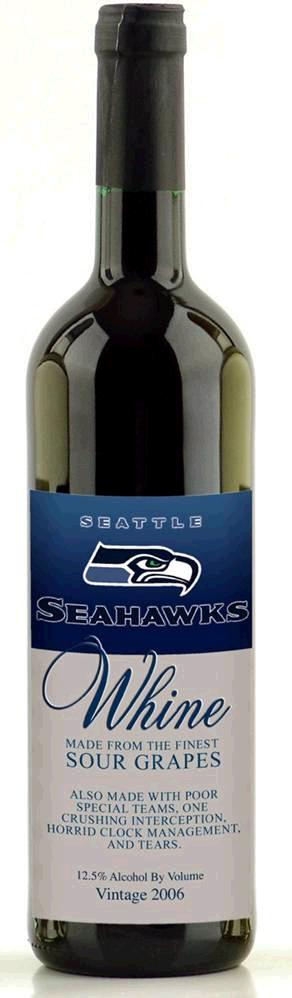
I don't know where this got started, and I'm a little reluctant to pour gasoline on this fire, but the image is too cool to pass up. Presenting: Seattle Whine
The label as a whole reads:
Seattle Seahawks
Whine
Made from the Finest Sour Grapes
Also Made with Poor Special Teams,
One Crushing Interception,
Horrid Clock Management,
and Tears
12.5% Alcohol by Volume
Vintage 2006
Wednesday, February 15, 2006
Infantilizing City Government
The P-G's headline over this piece is so perfect that I copied it. I only wish that I had had the time to act on my first instinct -- revulsion at the idea of the City of Pittsburgh mandating that city employees use the Internet for no more than 30 minutes per day. The City of Pittsburgh steps boldly forward into the future -- by all but unplugging itself from the Internet?
The overall impression of this small act is a governance system with no relationship to reality. There is no sense of a city governance system at all. Rather, a (new) small clique meandering into a looming crisis of which we (and they) are only vaguely aware. This small act just looks desperate and pathetic.
Intelligent Design Presentation by the ACLU
This arrived in my in-box and may be of broader interest:
Evolution, Shmevolution:
The Dover Intelligent Design Trial and Why It Matters
with ACLU-PA Legal Director and Lead Attorney
Witold (Vic) Walczak
Monday, February 20, 2006 at 7:00 pm
Parran Hall Auditorium - G23
University of Pittsburgh Graduate School of Public Health
Fifth Avenue and Bouquet Street
The program is free and open to the public.
In his first local presentation since the judge's decision was handed down in the landmark case, Walczak will provide a first-hand account of the issue and the trial.
This event is sponsored by a collaboration of local ACLU groups including the University of Pittsburgh ACLU undergraduate student group, the University of Pittsburgh Law School ACLU student group, the Carnegie Mellon ACLU student group and the Greater Pittsburgh Chapter of the ACLU of Pennsylvania.
Evolution, Shmevolution:
The Dover Intelligent Design Trial and Why It Matters
with ACLU-PA Legal Director and Lead Attorney
Witold (Vic) Walczak
Monday, February 20, 2006 at 7:00 pm
Parran Hall Auditorium - G23
University of Pittsburgh Graduate School of Public Health
Fifth Avenue and Bouquet Street
The program is free and open to the public.
In his first local presentation since the judge's decision was handed down in the landmark case, Walczak will provide a first-hand account of the issue and the trial.
This event is sponsored by a collaboration of local ACLU groups including the University of Pittsburgh ACLU undergraduate student group, the University of Pittsburgh Law School ACLU student group, the Carnegie Mellon ACLU student group and the Greater Pittsburgh Chapter of the ACLU of Pennsylvania.
Pittsburgh Curls
The Turin Olympics are bringing the hottest sport on ice back into the public eye: curling. If you want to take the plunge yourself, check out the Pittsburgh Curling Club.
Tuesday, February 14, 2006
Guilty, Guilty, Guilty!
Though one of my themes on this blog is the need for Pittsburgh to be more proactive in building (economic) (technological) bridges to other regions, I've failed as badly as anyone at putting my money -- or at least my links -- where my mouth is.
So over to the right, I am starting a collection of links to regional tech and business blogs that focus on other parts of the country. (I'm also happy to include blogs that address technology communities outside the U.S.) This can't be a comprehensive list, but I'd like to include a representative lot from both mature technology communities and from growing and/or struggling ones. Feel free to suggest links by email or in the Comments.
So over to the right, I am starting a collection of links to regional tech and business blogs that focus on other parts of the country. (I'm also happy to include blogs that address technology communities outside the U.S.) This can't be a comprehensive list, but I'd like to include a representative lot from both mature technology communities and from growing and/or struggling ones. Feel free to suggest links by email or in the Comments.
Monday, February 13, 2006
PUMP Presents Discover Pittsburgh!
Cut and pasted from the PUMP site:
February 23, 2006 5:30 – 8:30 PM
Soldiers and Sailors Memorial Hall in Oakland
Discover Pittsburgh 2006!
Come discover how to make Pittsburgh your own!
Whatever you want, Pittsburgh has it!
Join us February 23rd to meet representatives from Pittsburgh’s business, cultural, recreational, and educational communities. Enjoy refreshments and a chance to network with other young and young-thinking people from YOUR Pittsburgh!
PUMP is pleased to provide this program FREE of charge to the public!
Date: February 23rd
Time: 5:30 – 8:30 PM
Location: Soldiers and Sailors Memorial Hall, 4141 Fifth Avenue, Oakland
Refreshments by the Common Plea. For additional information, please call 412-338-2133. RSVPing in advance will automatically enter you into our door prize drawing! Must be present to win!
Interested in exhibiting your company/organization to hundreds of college students and young professionals?
Click Sponsorship Tiers [from the link above] for pricing information and Registration Form to register! You may also register online. Just click here. [Go to the link above.] Once you have created your username (please use your company/organization's name for your username) and password, simply log in and click 'Events Main Page' on the left hand side of your screen. Interested in advertising options? Click here. [Ditto.] If you have any questions, please do not hesitate to contact the PUMP office at pump@pump.org or 412-338-2133.
February 23, 2006 5:30 – 8:30 PM
Soldiers and Sailors Memorial Hall in Oakland
Discover Pittsburgh 2006!
Come discover how to make Pittsburgh your own!
Whatever you want, Pittsburgh has it!
Join us February 23rd to meet representatives from Pittsburgh’s business, cultural, recreational, and educational communities. Enjoy refreshments and a chance to network with other young and young-thinking people from YOUR Pittsburgh!
PUMP is pleased to provide this program FREE of charge to the public!
Date: February 23rd
Time: 5:30 – 8:30 PM
Location: Soldiers and Sailors Memorial Hall, 4141 Fifth Avenue, Oakland
Refreshments by the Common Plea. For additional information, please call 412-338-2133. RSVPing in advance will automatically enter you into our door prize drawing! Must be present to win!
Interested in exhibiting your company/organization to hundreds of college students and young professionals?
Click Sponsorship Tiers [from the link above] for pricing information and Registration Form to register! You may also register online. Just click here. [Go to the link above.] Once you have created your username (please use your company/organization's name for your username) and password, simply log in and click 'Events Main Page' on the left hand side of your screen. Interested in advertising options? Click here. [Ditto.] If you have any questions, please do not hesitate to contact the PUMP office at pump@pump.org or 412-338-2133.
Sunday, February 12, 2006
Burgh Economy Finds Salvation
From sportspickle.com (thanks, Stu):
The City of Pittsburgh, long known for the steel industry that gave the town’s beloved Steelers football team its name, now has an economy almost entirely based on the manufacturing and sale of Terrible Towels and other Steelers merchandise, according to a recent economic review of the city.
“The outstanding play of the Steelers over the past few years has not only reinvigorated the team’s already devoted fanbase, but it has also given the city an industry that has provided new jobs for more than 100,000 residents – the design, production and sale of Terrible Towels and other team apparel,” said Pittsburgh mayor Bob O’Connor. “In fact, nearly every citizen of the great city of Pittsburgh is today in some way employed by our exploding Terrible Towel industry.”
Pittsburgh is "The College City"
Here's an interesting website for would-be Pittsburgh college students: The College City.
State Subsidizes Local Tech
If the state is ponying up lots of new money for tech, then why is the local tech jobs market growing so slowly?
In technology companies, and especially in biotech firms, investment capital doesn't translate immediately into lots of jobs. Still, is it a good thing that the local start-up economy seems to depend so heavily on public funding? Are government subsidies the right foundation for a technology-oriented economy? Or would being forced to hunt aggressively for private capital, a hunt that would require building bridges to other regions, make Pittsburgh better off in the long run? Generally, I think that full privatization would be better, and I'd rather see cooperative bridges built to regions outside the state. The exception might be this: A persuasive case might be made that private capital won't follow unless public capital is in place. If that's the case, then public funding might make sense. Generally, though, I suspect that this isn't true.
Moreover, are government subsidies for tech companies the best use of our tax dollars? I think that PA has more pressing spending priorities. Local development authorities may serve valuable incubating, screening, and seeding functions, but we can only see their real value -- and we can only see genuine competition in that market from private firms -- if we turn off the public tap.
UPDATE: Harold Miller critiques the business tax pieces of the Governor's budget.
In technology companies, and especially in biotech firms, investment capital doesn't translate immediately into lots of jobs. Still, is it a good thing that the local start-up economy seems to depend so heavily on public funding? Are government subsidies the right foundation for a technology-oriented economy? Or would being forced to hunt aggressively for private capital, a hunt that would require building bridges to other regions, make Pittsburgh better off in the long run? Generally, I think that full privatization would be better, and I'd rather see cooperative bridges built to regions outside the state. The exception might be this: A persuasive case might be made that private capital won't follow unless public capital is in place. If that's the case, then public funding might make sense. Generally, though, I suspect that this isn't true.
Moreover, are government subsidies for tech companies the best use of our tax dollars? I think that PA has more pressing spending priorities. Local development authorities may serve valuable incubating, screening, and seeding functions, but we can only see their real value -- and we can only see genuine competition in that market from private firms -- if we turn off the public tap.
UPDATE: Harold Miller critiques the business tax pieces of the Governor's budget.
More on What to Call Pittsburghers
My last post provoked some excellent, thoughtful comments, and I thank everyone who chimed in. I'm not persuaded that my original use of "Yinzer" was classist, but I am persuaded that the term is a pretty complicated thing. It would have been wiser not to use it in the first place, and I won't use it in the future.
Continued conversation is welcome.
Continued conversation is welcome.
Thursday, February 09, 2006
What Do You Call a Steeler Fan?
Commenting on the title to my last post, Jonathan Barnes pointed out that many Pittsburghers cringe -- and worse -- at the "Yinzer" label. So in the title, I crossed it out.
Should I have done that? The question isn't respect for Jonathan's opinion; the question is whether some meaningful number of Pittsburghers cringe -- and whether that number overlaps in some relevant way with the 250,000 or so Steeler fans and others who crowded into Downtown on Tuesday for the Super Bowl parade and celebration. The title of the post and the Yinzer label, as I was using it, clearly referred to that crowd. If I was referring to 250,000 Steeler fans as Yinzers, was I being, as Jonathan suggests, "classist"? Or is it -- and I'll be provocative here for a moment -- "classist" to distance ourselves from the "Yinzer" label?
Commenters should tell me otherwise, but my non-native learning over the last several years tells me that a large, large number of people in this region are proud to refer to themselves -- and to be referred to -- as Yinzers. I'm using the term in a more general sense; I know that much of the time it has a narrower connotation -- particularly as it applies to people with a strong "Pittsburgh" accent. Borrowing a broader "people with strong emotional ties to the Pittsburgh area" meaning, I think, is fair. Pittsburgh wore its blue-collar, working class identity with pride during Super Bowl week, and to me "Yinzer" reads on that identity pretty closely, as does the exuberant and exhilarating passion that attaches to Steeler fan-dom. That passion is objectively irrational -- I like the Steelers and watch the games and get excited when they win, but it's a football team, everyone; nothing world-changing is at stake -- but you have to admire it. I'm willing to hypothesize that among any particular community, the passion is positively correlated with the strength of Pittsburgh's get-down-and-dirty self-image. We didn't have 250,000 investment bankers and neuroscientists downtown on Tuesday.
OK. Go ahead and tell me I'm wrong. Or not.
Should I have done that? The question isn't respect for Jonathan's opinion; the question is whether some meaningful number of Pittsburghers cringe -- and whether that number overlaps in some relevant way with the 250,000 or so Steeler fans and others who crowded into Downtown on Tuesday for the Super Bowl parade and celebration. The title of the post and the Yinzer label, as I was using it, clearly referred to that crowd. If I was referring to 250,000 Steeler fans as Yinzers, was I being, as Jonathan suggests, "classist"? Or is it -- and I'll be provocative here for a moment -- "classist" to distance ourselves from the "Yinzer" label?
Commenters should tell me otherwise, but my non-native learning over the last several years tells me that a large, large number of people in this region are proud to refer to themselves -- and to be referred to -- as Yinzers. I'm using the term in a more general sense; I know that much of the time it has a narrower connotation -- particularly as it applies to people with a strong "Pittsburgh" accent. Borrowing a broader "people with strong emotional ties to the Pittsburgh area" meaning, I think, is fair. Pittsburgh wore its blue-collar, working class identity with pride during Super Bowl week, and to me "Yinzer" reads on that identity pretty closely, as does the exuberant and exhilarating passion that attaches to Steeler fan-dom. That passion is objectively irrational -- I like the Steelers and watch the games and get excited when they win, but it's a football team, everyone; nothing world-changing is at stake -- but you have to admire it. I'm willing to hypothesize that among any particular community, the passion is positively correlated with the strength of Pittsburgh's get-down-and-dirty self-image. We didn't have 250,000 investment bankers and neuroscientists downtown on Tuesday.
OK. Go ahead and tell me I'm wrong. Or not.
Wednesday, February 08, 2006
How Many Yinzers Does It Take . . .

to celebrate a Super Bowl victory.
Answer: 250,000
Check out these very cool photostreams of the victory and victory parade:
http://www.flickr.com/photos/carafriez/96848247/in/pool-pittsburgh_steelers/
http://www.flickr.com/groups/pittsburgh_steelers/pool/
Tuesday, February 07, 2006
More on Wireless for Market Square
Lynne Kiesling has a friendly response to my comments on the foundation for wireless connectivity in Market Square. I have just a couple of additional thoughts:
Lynne writes:
I don't want to argue definitions with an economist. But note that the fact that wireless networks *can* be password-protected -- so that network operators *can* charge for access -- doesn't mean that they *should* be password-protected. If you assume that we're talking about open wireless, then a network for Market Square comes closer to being a "pure" public good, and we're back to my earlier diagnosis -- this may be a case for government provisioning. Put differently, if we assume the need for password-protection (i.e., excludability) we instantly identify some class of wireless users who are excluded from the network -- not by technology alone, but by price. Some substantial portion of the consumer surplus available via installation of the network would be transferred from consumers themselves to the local businesses that finance and charge for it; there would, also, be some deadweight loss.
If, in the abstract, we're willing to live with that, then fine. After all, private companies develop and charge for all kinds of things that are, like wireless connectivity, forms of "infrastructure." Electricity and other utilities; cable TV; water service; roads. But public regulation -- of price and quality of service -- is rarely far behind, because these sorts of things tend to be natural monopolies (yes, I know I'm again invoking an economist's term of art), and the risk of monopoly pricing is considerable. So if Pittsburgh somehow manages to get a private wireless network off the ground in Market Square or elsewhere in Downtown, and if the economics of that network are such that only one network is supportable, then it is likely fair -- to the citizens who would use the network -- to regulate it in the public interest.
Lynne writes:
I don't think that wireless connectivity is a public good, at least not a pure public good. A public good is something that is nonexcludable (I can't prevent you from consuming it) and nonrival (your consumption does not reduce my consumption). Wireless connectivity is nonrival up to a point, but it is congestible. Furthermore, we know that we can password protect and/or charge for access, which means that it is excludable. Thus on a purely technical level, wireless connectivity is not a public good.
I don't want to argue definitions with an economist. But note that the fact that wireless networks *can* be password-protected -- so that network operators *can* charge for access -- doesn't mean that they *should* be password-protected. If you assume that we're talking about open wireless, then a network for Market Square comes closer to being a "pure" public good, and we're back to my earlier diagnosis -- this may be a case for government provisioning. Put differently, if we assume the need for password-protection (i.e., excludability) we instantly identify some class of wireless users who are excluded from the network -- not by technology alone, but by price. Some substantial portion of the consumer surplus available via installation of the network would be transferred from consumers themselves to the local businesses that finance and charge for it; there would, also, be some deadweight loss.
If, in the abstract, we're willing to live with that, then fine. After all, private companies develop and charge for all kinds of things that are, like wireless connectivity, forms of "infrastructure." Electricity and other utilities; cable TV; water service; roads. But public regulation -- of price and quality of service -- is rarely far behind, because these sorts of things tend to be natural monopolies (yes, I know I'm again invoking an economist's term of art), and the risk of monopoly pricing is considerable. So if Pittsburgh somehow manages to get a private wireless network off the ground in Market Square or elsewhere in Downtown, and if the economics of that network are such that only one network is supportable, then it is likely fair -- to the citizens who would use the network -- to regulate it in the public interest.
Monday, February 06, 2006
P-G Your Biz Poll - Vote?
The Post-Gazette business section has an online poll about the Steelers. I was asked to vote. I did. So you should, too, I guess. But why?
Boselovic on a Roll
Len Boselovic has a great column this morning:
The answer, I think, is that the Steelers are far more tangible expression of the region's collective identity than "the local economy" is. "The local economy" doesn't have a color scheme or a theme song or a logo, and it certainly doesn't have an owner, or a coach, or a quarterback. As citizens of the region, "the Steelers" are fodder for appropriation into our own personal identities in a way that "the local economy" can never be.
[Paul] Allen's abiding interest in technology and culture is a reflection of Seattle just as much as Mr. Rooney's commitment to faith, family and hard work are a measure of Pittsburgh. Unfortunately, the very things that built a successful NFL franchise in Pittsburgh may not be the basis for a sound economy in the region.
Mr. Rooney's reluctance to change -- even when fickle, feckless fans wanted Mr. Cowher fired after last year's loss to the New England Patriots in the AFC championship game -- is inspiring. His decision was based on the confidence that Mr. Cowher was the right person for the job, a judgment vindicated by this year's amazing run to the Super Bowl. The Steelers' persistence in relying on the ground game, a strategy implemented with innovative flair in recent weeks, is also a reflection of that confidence in tradition.
Mr. Rooney's reluctance to change is based on a belief that the Steelers have the qualified personnel and sound game plan necessary to get the job done.
Pittsburgh's reluctance to change is based on a fear of change rather than confidence in our elected officials, economic development minions and business leaders. In so many ways, the old isn't working any more, no matter how desperately they embrace it.
Jobs grew at a 3.5 percent pace in Seattle last year. In Pittsburgh, they are forecast to grow 1 percent this year, which would mark the regional economy's best showing in five years.
If the Steelers had a record like that, we'd be marching in the streets calling for Mr. Cowher's head. Why isn't there the same sense of outrage over the economy?
The answer, I think, is that the Steelers are far more tangible expression of the region's collective identity than "the local economy" is. "The local economy" doesn't have a color scheme or a theme song or a logo, and it certainly doesn't have an owner, or a coach, or a quarterback. As citizens of the region, "the Steelers" are fodder for appropriation into our own personal identities in a way that "the local economy" can never be.
Good for America
Go ahead: We're thinking it, so someone might as well say it.
What's good for the Steelers is good for America.
What's good for the Steelers is good for America.
In the five years the Steelers have played in the Super Bowl, the Standard & Poor's 500 has advanced an average of 22 percent annually, more than double the 8.6 average annual gain the index has racked up since the game was first played in 1967.
While the Steelers lost in their most recent Super Bowl appearance, the market has never had a losing year when the Steelers appear in the game. The S&P's worst performance for a Steelers year was 1979, when it advanced 12.3 percent after the Steelers beat the Cowboys in Super Bowl XIII, 35-31.
Saturday, February 04, 2006
Itty-Bitty PTC Business Plan Competition
The Pittsburgh Tech Council's Enterprize Business Plan Competition kicks off soon. Top prize is all of $50,000.
Angels in Pittsburgh
Cori Shropshire reports from the Angel Venture Fair:
And here I thought that the point of starting a company was to deliver products and services to customers who wanted to buy them. Seriously: I'm no business pro, but why start a company unless you have some pretty good sense of who your customers are? And intellectual property rights are no good unless they offer a meaningful barrier to entry. Your customers are yours only so long as you can keep them from becoming your competitors' customers.
Investors and entrepreneurs who put "intellectual property" at the top of their priority list are putting the cart before the horse -- and I say this as someone who practiced IP law and writes and teaches about IP law for a living. There are a lot of ways for a new company to establish and protect a market position, and intellectual property rights offer several. But "barriers to entry" is a broader and more important concept than IPRs (and I hate how corporate-speak reduces patent and copyright law to IPRs), and having customers is the most important concept of all.
Veteran investor Chester Fisher offers a glimpse into what "angels" really want. Companies, he said, must have a unique idea, a plan to protect the intellectual property behind that idea and a solid business plan that shows how they will market and sell products derived from their unique idea. "The whole purpose of these pitches is to get [investors] just interested enough to talk to the company and learn more," said Mr. Fisher, who was on hand to hear first-hand from hopeful companies at Thursday's fair. Mr. Fisher, who has invested in 15 to 20 local start-ups and with his partner, Tom Canfield, runs Squirrel Hill-based Equity Catalyst, an investment banking firm that helps young companies find money, said he was impressed by what he heard and saw.
And here I thought that the point of starting a company was to deliver products and services to customers who wanted to buy them. Seriously: I'm no business pro, but why start a company unless you have some pretty good sense of who your customers are? And intellectual property rights are no good unless they offer a meaningful barrier to entry. Your customers are yours only so long as you can keep them from becoming your competitors' customers.
Investors and entrepreneurs who put "intellectual property" at the top of their priority list are putting the cart before the horse -- and I say this as someone who practiced IP law and writes and teaches about IP law for a living. There are a lot of ways for a new company to establish and protect a market position, and intellectual property rights offer several. But "barriers to entry" is a broader and more important concept than IPRs (and I hate how corporate-speak reduces patent and copyright law to IPRs), and having customers is the most important concept of all.
High Times in Pittsburgh Today
Two New York Times writers . . . two Pittsburgh natives . . . two paeans to their hometown on the Times op-ed page this morning:
Holly Brubach, Gridiron City:
John Tierney, Smells Like Team Spirit:
Holly Brubach, Gridiron City:
The Steelers have historically gone about football the way people in Pittsburgh have gone about their lives. It occurs to me that what may appear to be a lack of pride is, more precisely, an acknowledgment that the city simply can't compete when it comes to the things American culture calls important: celebrity, fashion, fancy cars. Not because Pittsburgh has tried for all that and failed, but because here those aren't the things that matter. This may not be a popular position we've inherited, but we're sticking to it, and looking to the Super Bowl for vindication.
John Tierney, Smells Like Team Spirit:
Die-hard sports fans tend to be less lonely and depressed than average, presumably because they're satisfying their inner Stone Age warrior. Fake wars are a healthy outlet for those yearnings to unite and vanquish the enemy clan. But turning politics into a war between good and evil is not so satisfying, because neither side ever wins and the public grows tired of the spectacle. . . . Most Americans aren't wildly partisan, but they're stuck with a national political debate led by the new tribes at the extreme of each party . . . . As those extremists have come to dominate Congress, the State of the Union address has been looking more and more like the Super Bowl. . . . So next year we should have more T-shirts and more innovations [at the State of the Union] -- maybe team hats, which the Capitol police told me would be acceptable. The police spokeswoman wasn't sure about Terrible Towels, but after the Steelers win the Super Bowl, look for red and blue rags waving during next year's speech. Just don't expect either side to be as happy as the Steeler fans tomorrow.
Friday, February 03, 2006
Get Your Steelers Fight Songs
Well, most of them aren't classy, and most of them aren't classics, but you can get your fill of Steelers fight songs at http://www.steelersinhoboken.com/Fight_Songs.htm
I'll say it once and only once: Go Steelers!
I'll say it once and only once: Go Steelers!
Steel City bends into Seattle mold
Seattle P-I business columnist has a good column today on Pittsburgh's technology community. In "Steel City bends into Seattle mold," John writes:
Dietrick (from local VC Birchmere) and Jay Katarincic (from local VC Draper Triangle) argue that the Pittsburgh region is moving in the right direction but would benefit from . . . more venture funding. No surprise there; raising local money and attracting outside VC interest continues to be a struggle. But money alone won't solve Pittsburgh's problems. Cook continues, quoting someone we know:
Could the smokestack- belching image that has defined Pittsburgh for decades eventually give way to a high-tech city that more closely resembles Seattle?
Pittsburgh venture capitalist Chuck Dietrick knows it won't be easy, but he thinks the Steel City is slowly making the transformation to a place where innovative software, semiconductor and life science startups can thrive.
Dietrick (from local VC Birchmere) and Jay Katarincic (from local VC Draper Triangle) argue that the Pittsburgh region is moving in the right direction but would benefit from . . . more venture funding. No surprise there; raising local money and attracting outside VC interest continues to be a struggle. But money alone won't solve Pittsburgh's problems. Cook continues, quoting someone we know:
"Steel was so big here, and steel was so important for so long, that the region never had the need to develop the culture of personal entrepreneurship that comes so naturally to many communities on the West Coast," said Madison. "Business in Pittsburgh meant 'Big Business,' and 'Big Business' was the job of men who went downtown in the morning and ran the world. ... There's a CEO mentality to Pittsburgh, not an entrepreneurial culture. And I think that the mentality holds the region back economically."
More on Market Square
Lynne Kiesling responds to my Market Square post with a long, sympathetic analysis of street life and vehicular traffic. Lynne endorses Patricia Lowry's argument that one great way to revive Market Square would be to add wireless connectivity -- and that the city should encourage and nurture the activities of wireless carriers but not get into the business of offering wireless itself. (As has, say, Philadelphia.)
The answer is pretty obvious, at least to me: The city, or some public authority, is the right entity to be involved precisely because it's far from clear that the businesses in and around the square and PPG Place either would, in fact, benefit from this, or would recognize those benefits, to such an extent that they would be willing to underwrite the cost of the network. It's an empirical question, right? Figure out who the relevant businesses are (do we count street-level only, or do we count tenants of PPG Place?), and ask them: If everyone chipped in, would you be willing to fund some share of a wireless network for that space? My guess is that the answer would be no. But I'm happy to be proved wrong.
Wireless connectivity in public spaces is, I think, what economists would call a public good, and that means that we shouldn't be so quick to write off government involvement in setting it up in the first place. Or, if the private sector does get this off the ground, then some government entity should be closely involved in regulating both services and prices, so that the public truly gets what the public needs.
But here's my question: why should it be the city's doing? The businesses in Market Square and around PPG Plaza would be the largest beneficiaries of a wireless Market Square. They should have an incentive to provide it. Perhaps the Mayor could encourage, suggest, facilitate, but let private initiative make it happen.
The answer is pretty obvious, at least to me: The city, or some public authority, is the right entity to be involved precisely because it's far from clear that the businesses in and around the square and PPG Place either would, in fact, benefit from this, or would recognize those benefits, to such an extent that they would be willing to underwrite the cost of the network. It's an empirical question, right? Figure out who the relevant businesses are (do we count street-level only, or do we count tenants of PPG Place?), and ask them: If everyone chipped in, would you be willing to fund some share of a wireless network for that space? My guess is that the answer would be no. But I'm happy to be proved wrong.
Wireless connectivity in public spaces is, I think, what economists would call a public good, and that means that we shouldn't be so quick to write off government involvement in setting it up in the first place. Or, if the private sector does get this off the ground, then some government entity should be closely involved in regulating both services and prices, so that the public truly gets what the public needs.
Thursday, February 02, 2006
Angel Venture Fair
Today was the Innovation Works/PTC Pittsburgh "Angel Venture Fair," a beauty pageant for 13 tech startups desperately in need of money and publicity.
I didn't go, not because I'm not interested but because I have a day job. Still, I thought it was both curious and emblematic, in a way, that the event was held at the Duquesne Club. How typically Pittsburgh to hold an emerging company event at the premier symbol of the city's old industrial moneyed heritage.
The Biz Times lists the finalists as:
Caracal Semiconductor; Cardinal Resources, Inc.; Carnegie Speech Company, Inc.; ChemDAQ Corp.; Embrace Pet Insurance; FireFly; Power Technologies; Perioptimum; PetsDx Veterinary Imaging; Proteopure, Inc.; Mid-Market America, Inc.; StageMark; and Thorley Industries. (Interesting that two of the 13 are pet-oriented.)
At least the losing competitors could walk out with bags of coconut macaroons.
I didn't go, not because I'm not interested but because I have a day job. Still, I thought it was both curious and emblematic, in a way, that the event was held at the Duquesne Club. How typically Pittsburgh to hold an emerging company event at the premier symbol of the city's old industrial moneyed heritage.
The Biz Times lists the finalists as:
Caracal Semiconductor; Cardinal Resources, Inc.; Carnegie Speech Company, Inc.; ChemDAQ Corp.; Embrace Pet Insurance; FireFly; Power Technologies; Perioptimum; PetsDx Veterinary Imaging; Proteopure, Inc.; Mid-Market America, Inc.; StageMark; and Thorley Industries. (Interesting that two of the 13 are pet-oriented.)
At least the losing competitors could walk out with bags of coconut macaroons.
Pittsburgh Gives Detroit Hope
And people sometimes say that I'm too positive about Pittsburgh. Check out Tracy Certo's take, for the benefit of a Detroit readership.
And she forgot to mention . . . the hordes of highly-educated workers who throng to the city every month from states and countries far and wide . . . the city's bank account has never been fuller . . . the Pirates and Penguins are headed for the championships that we've come to expect year in and year out . . . and every morning a chorus of angels sings the sun high into the sky . . . .
Spotted at ADB.
Today Pittsburgh is a great place to live. It’s a small big city with all the advantages of a larger city — culturally, may I just say we’re kicking butt? — and far fewer problems. Our commute is short. It’s easy to network here and get in the loop. We have world-class universities and hospitals. A music and art scene that’s exploding. Really friendly people (we can’t stress this enough). Neighborhood bars where you can drink the legendary shot and beer as well as first-rate museums and restaurants, scads of coffee houses and a long list of wide-ranging cultural events every week to choose from. And, oh yeah, a Super Bowl team.
And she forgot to mention . . . the hordes of highly-educated workers who throng to the city every month from states and countries far and wide . . . the city's bank account has never been fuller . . . the Pirates and Penguins are headed for the championships that we've come to expect year in and year out . . . and every morning a chorus of angels sings the sun high into the sky . . . .
Spotted at ADB.
Downtown Retail
 Quote of the week, buried in the Post-Gazette:
Responding to New York architect and developer Stan Eckstut's observation that Downtown Pittsburgh has too much public open space for a healthy retail environment, electrical engineer Alan R. Huffman of Pine writes: "The greatest damage to the retail environment in Downtown Pittsburgh has been done, in my opinion, by continuing to construct large office buildings with no first-floor retail space. I worked Downtown for many years and watched this take place along Liberty Avenue and around the PPG building as well as many other locations. Many street-front retail and hospitality locations were wiped out by this construction. It's a trend that probably dates at least back to the Gateway redevelopment."
Straight to the truth. Paging Jane Jacobs!
Six More Weeks of Winter
 So said Punxsutawney Phil this morning. The PA Tourism Office would like you to think that they had something to do with this. But they didn't. It's all on Phil.
Celebrate by watching that all-time classic of existentialist comedy. Again.
Wednesday, February 01, 2006
Seattle High Tech
Seattle Post-Intelligencer writer John Cook has a local high tech/venture blog at http://blog.seattlepi.nwsource.com/venture/. It's purely a coincidence, I'm sure, given the fact that the Seahawks are playing the Steelers on Sunday, but John emailed me today for some thoughts on Pittsburgh's venture and entrepreneurial communities. I wrote him back; I'm looking forward to his story. Stay tuned for a link.
"Pittsburgh's Future"
I'm told that this new group, "Pittsburgh's Future," is operated by Harold Miller, formerly of the Allegheny Conference. Can't tell much more than that, though.
 Can Pittsburgh?
Subscribe to:
Posts (Atom)