Friday, September 29, 2006
Pittsburgh Restaurants
I have friends coming to Pittsburgh next weekend, and I'm looking for restaurant reviews, since I don't get out enough to keep up with this stuff. Pittsburgh doesn't have Zagat's, but this is pretty helpful (even though it represents the opinions of a pretty small sample!) -- since it's pretty up-to-date. And for the restaurants that I've visited, it tracks my experiences pretty well.

Wednesday, September 27, 2006
Where Am I?
Hills? Check.
Cable cars? Check.
Public wireless infrastructure? Check.
Public transit information available via Google tools? Check.
Young, hip mayor? Check.
Zealous anti-smoking ordinance? Check.
Once proud pro football team, with a history of Super Bowl success, now struggling to find its feet? Check.
Yep. I live in San Francisco.
Cable cars? Check.
Public wireless infrastructure? Check.
Public transit information available via Google tools? Check.
Young, hip mayor? Check.
Zealous anti-smoking ordinance? Check.
Once proud pro football team, with a history of Super Bowl success, now struggling to find its feet? Check.
Yep. I live in San Francisco.
HELP Moves Forward
Congrats to Gary Rosensteel and his HELP umbrella for sustaining a series of provocative presentations:
Don Smith, who runs the Oakland KIZ and the University Partnership, is HELP's guest for the October meeting (October 10, Doc's in Shadyside, 5:30 p.m). And Rich Lunak, head of Innovation Works, is HELP's guest for the November meeting (Doc's again, 5:30, November 14).
In one sense, Don and Rich are "usual suspects" in Pittsburgh's entrepreneurship space, but in a more important sense, they're hubs of productive activity. These HELP meetings are great opportunities to talk with them outside the confines of the usual big talk-and-powerpoint environment. Good for Don and Rich for agreeing to participate, and good for Gary for keeping up the program.
Don Smith, who runs the Oakland KIZ and the University Partnership, is HELP's guest for the October meeting (October 10, Doc's in Shadyside, 5:30 p.m). And Rich Lunak, head of Innovation Works, is HELP's guest for the November meeting (Doc's again, 5:30, November 14).
In one sense, Don and Rich are "usual suspects" in Pittsburgh's entrepreneurship space, but in a more important sense, they're hubs of productive activity. These HELP meetings are great opportunities to talk with them outside the confines of the usual big talk-and-powerpoint environment. Good for Don and Rich for agreeing to participate, and good for Gary for keeping up the program.
Saturday, September 23, 2006
Mysteries of Pittsburgh
I am regularly reminded of just how difficult it is for outsiders to break in to the networks that structure Pittsburgh's social and cultural patterns -- at just about every level (region, city, neighborhood, community, society, politics, business, jobs, fun, etc. etc.).
The other day, I started to wonder: Who, exactly, are these people who (some imagine) govern so much of our outsider lives and leave us wondering -- what else do we have to do to be accepted around here?
I suspect that many of them are imaginary; it's not "they" who maintain these boundaries, but often "us" who don't work hard enough at identifying and understanding local traditions.
Nevertheless, is there a small local "they"? "They" would be private networks and organizations that stay off the public radar screen but seem to wield significant influence in local politics, culture, and business. The Allegheny Conference on Community Development is *not* what I'm talking about; the Conference is as public as it can be, and its influence on local politics, culture, and business is far smaller than it would like -- despite occasional and objectively inexplicable nods in its direction.
What and who are the hidden power sources in Pittsburgh?
The other day, I started to wonder: Who, exactly, are these people who (some imagine) govern so much of our outsider lives and leave us wondering -- what else do we have to do to be accepted around here?
I suspect that many of them are imaginary; it's not "they" who maintain these boundaries, but often "us" who don't work hard enough at identifying and understanding local traditions.
Nevertheless, is there a small local "they"? "They" would be private networks and organizations that stay off the public radar screen but seem to wield significant influence in local politics, culture, and business. The Allegheny Conference on Community Development is *not* what I'm talking about; the Conference is as public as it can be, and its influence on local politics, culture, and business is far smaller than it would like -- despite occasional and objectively inexplicable nods in its direction.
What and who are the hidden power sources in Pittsburgh?
A Little Pittsburgh Boosterism Doesn't Hurt
Allison asked me to plug the National Geographic magazine's recent mini-feature on Pittsburgh, so here it is:
That's a little over the top, even for me. But remember National Geographic's motto: Celebrate What's Right with the World.
What's most surprising? It's beautiful. Thanks to a 15-year urban renewal program, the city has been revived, morphing from a stronghold of industry into a place that better reflects the surrounding Allegheny Mountains.
This sort of integration into the natural setting is precisely what makes a top-notch adventure city, and, in achieving it, Pittsburgh has become a place where residents can be serious both about their careers and their outdoors. The same shift away from heavy industry that beautified the skyline has also reordered the economy: Over the past decade, hundreds of technology companies of all sizes have set up shop in the Steel City. Still, relocators can take advantage of home prices that remain well below the national average and renovation opportunities in the increasingly trendy downtown zones, such as the artist-filled Oakland neighborhood.
That's a little over the top, even for me. But remember National Geographic's motto: Celebrate What's Right with the World.
Friday, September 22, 2006
Great Race on Sunday
I'll be running, er, jogging, in next Sunday's Great Race. Look for me toward the back of the pack as we move up and down the Boulevard of the Allies.
Today's pre-race coverage includes this weird quotation from someone who, like me, doesn't have a typical runner's physique:
"Some guy who's 6-2, 6-3 and kind of muscular is going to weigh at least 200 pounds. I don't think your old noseguard or someone like that enters races."
Well, Steve: The first part is true, but the second part ain't. I ran, er, jogged, San Francisco's Bay to Breakers 10K for many years, on a course that's much tougher than what the Great Race offers. In several races I saw the San Francisco 49ers offensive line running, er, jogging, with the rest of the throng. Sometimes they ran with an old quarterback. I know that I ran by Jim Plunkett one year.
Today's pre-race coverage includes this weird quotation from someone who, like me, doesn't have a typical runner's physique:
"Some guy who's 6-2, 6-3 and kind of muscular is going to weigh at least 200 pounds. I don't think your old noseguard or someone like that enters races."
Well, Steve: The first part is true, but the second part ain't. I ran, er, jogged, San Francisco's Bay to Breakers 10K for many years, on a course that's much tougher than what the Great Race offers. In several races I saw the San Francisco 49ers offensive line running, er, jogging, with the rest of the throng. Sometimes they ran with an old quarterback. I know that I ran by Jim Plunkett one year.
Wednesday, September 20, 2006
Biotech Tech Transfer
The Milken Institute has put out a new report on commercialization of biotech research by universities worldwide. The report can be downloaded here. (Be careful; it's huge.)
The title is "Mind to Market: A Global Analysis of University Biotechnology Transfer and Commercialization." Here are the "key findings":
Run a search through the PDF to see how Pitt stacks up worldwide in biotech commercialization. My very quick take: For all the money that Pitt invests in biomedical research -- not so well.
The title is "Mind to Market: A Global Analysis of University Biotechnology Transfer and Commercialization." Here are the "key findings":
• Harvard ranks first in terms of biotech research, as measured by papers and citations, followed by the University of Tokyo and University of London. U.S. universities hold eight of the top 10, and 28 of the top 40 positions. California universities hold five of the top 25 rankings; the UK and Japan hold three each.
• The University of Texas system scores first on our Biotech Patent Composite Index, followed by UC San Francisco — which is likely first among individual campuses since the University of Texas doesn’t report data on individual campuses — and Johns Hopkins. Nine of the top 10 patent holders are U.S. universities. The University of London ranks first among foreign universities (10th overall). (U.S.-issued university biotech patents grew from a cumulative total of 433 through 1995 to 11,430 in 2004.)
• Our University Technology Transfer and Commercialization Index shows MIT first on outcome measures, which include such factors as licensing income and startups. The University of California system ranks second (led by UC San Francisco), with Caltech third, Stanford fourth and Florida fifth. The University of British Columbia was the highest-ranked Canadian institution, coming in eighth overall.
• Among U.S., Canadian and European universities, the United States leads in invention disclosures, patents filed and granted, licenses executed and licensing income. However, European universities surpass their U.S. counterparts in startups established.
• Research activity has a high rate of return. Each 10-point increase in our Research Papers score contributes an additional $1.7 million in annual licensing income.
• Investments into OTTs also offer high returns. For every $1 invested in OTT staff, the university receives a little more than $6 of licensing income.
• In terms of job creation, the Amgens and Genentechs most differentiate the economic impact of U.S. university-based biotech commercialization that originates from universities in other nations.
Run a search through the PDF to see how Pitt stacks up worldwide in biotech commercialization. My very quick take: For all the money that Pitt invests in biomedical research -- not so well.
The Economist Likes Us. It Really Likes Us!
The story in this week's Economist magazine is locked up in the "premium content" section, but you can get there without a subscription by watching an ad:
How now brown town?
A former steel city is now proclaiming its cleaner land and clever minds
. . . . A couple of decades after the collapse of the local steel industry prompted many Pittsburghers to flee, the city has a rosier future.
Pittsburgh will not experience an explosion of population and investment, like the booming cities of America's south-west. But it is part of a pleasant and affordable region with an improving mix of industries and enviable demographics—which is as much as many parts of the country can hope for. . . .
. . . . The SouthSide Works aside, however, plenty of clever young people already seem to be staying. Although the region's overall education levels are not that impressive, says Chris Briem, an economist at the University of Pittsburgh, those figures are partly skewed by its high ratio of elderly residents. Among Pittsburghers 25-34 years old, by contrast, 41.9% have graduated from university, placing the city among America's top ten. More than 17% of those young people have also earned an additional graduate or professional degree: the fourth-highest share in the country, behind only Washington, DC (think lawyers), Boston and San Francisco.
Much of Pittsburgh's drive to clean up brownfield sites is more mundane than SouthSide Works, or the engineering and biotech labs in the city's universities. But it is nonetheless useful in updating and rounding out the local economy. The city has plenty of land near the airport, for example, that will soon be accessible on a new highway spur connected to the interstate system. That could be appealing to companies looking for new places to put distribution centres—a crucial bit of America's logistics-driven economy. Some of this land is undercut by old mines, so the government is blasting the mines open, filling areas back in and then flattening them out.
These efforts have a clear logic to them. Pittsburgh is within one day's drive, or a short flight, of the whole eastern seaboard, which accounts for more than half of America's retail sales. But it has lower costs than the big coastal cities. Its potential appeal as a logistics hub thus gives it a fighting chance of attracting the sort of distribution investments that have helped such cities as Louisville, Kentucky and Memphis, Tennessee, though on a smaller scale. A few thousand such jobs would help many locals with moderate levels of education. The city is already showing off a sprawling distribution facility for Dick's Sporting Goods, a big retailing chain.
As Pittsburgh upgrades its local economy, it will increasingly have demography on its side. Because so many prime-age workers moved away in the early 1980s—often taking children with them—it now has lots of old folk. At the last census, in 2000, 15.6% of Pennsylvania's population was over 64 years old—second only to Florida—and the Pittsburgh region is older than the rest of the state. But now the Grim Reaper will even things out. Over the next quarter-century, however, the Census Bureau expects Pennsylvania's over-64 population to grow by only 50%, the smallest increase of the 50 states. The national elderly population will grow more than twice as quickly, while that of currently vibrant states in America's south-west will explode. When today's most glamorous regions begin to face that brutal arithmetic, many of today's young Pittsburghers may be glad they stayed put.
Tuesday, September 19, 2006
Can Blogging Save the World?
REWIRING THE MEDIA, A PUBLIC TALK BY ETHAN ZUCKERMAN
September 27, 2006, 12 Noon, Kurtzman Room, William Pitt Student Union, University of Pittsburgh. Ethan Zuckerman of the Berkman Center for Internet and Society at Harvard Law School talks about the power of blogging as a news source for human rights and current issues. He co-founded Global Voices, the international blogging project that closes gaps in mainstream media coverage. His Geekcorps sends IT volunteers to work on projects in developing nations, especially West Africa. Previously Ethan helped found Tripod.com, one of the web's first "personal publishing" sites. He blogs at http://blog.ethanzuckerman.com, http://www.globalvoices.org, and http://www.worldchanging.com and lives in the Berkshire Mountains of western Massachusetts, USA with his wife and a small, fluffy cat.
Part of International Week at the University of Pittsburgh: http://www.ucis.pitt.edu/internationalweek
September 27, 2006, 12 Noon, Kurtzman Room, William Pitt Student Union, University of Pittsburgh. Ethan Zuckerman of the Berkman Center for Internet and Society at Harvard Law School talks about the power of blogging as a news source for human rights and current issues. He co-founded Global Voices, the international blogging project that closes gaps in mainstream media coverage. His Geekcorps sends IT volunteers to work on projects in developing nations, especially West Africa. Previously Ethan helped found Tripod.com, one of the web's first "personal publishing" sites. He blogs at http://blog.ethanzuckerman.com, http://www.globalvoices.org, and http://www.worldchanging.com and lives in the Berkshire Mountains of western Massachusetts, USA with his wife and a small, fluffy cat.
Part of International Week at the University of Pittsburgh: http://www.ucis.pitt.edu/internationalweek
Monday, September 18, 2006
Talking Pittsburgh Heads
The Pittsburgh Regional Alliance, promoter of Pittsburgh's economy (and hand-in-glove ally of the Allegheny Conference), has released "a new resource designed exclusively for members of the media. This program is designed for editors and producers for the specific purpose of providing national news programmers with credible sources for expert analysis and insight." The title is "For Attribution: A Directory of Knowledge Experts from the Pittsburgh Region. And the list of experts is an interesting snapshot of who's in -- and who's out -- among Pittsburgh movers and shakers:
BUSINESS, INDUSTRY, & ECONOMIC DEVELOPMENT
Heather Arnet
Executive Director, The Women and Girls Foundation of SWPA
Helen Hanna Casey
President, Howard Hanna Real Estate Services
Kathy Criss, CBCP
Director, Disaster Management Center, University of Pittsburgh Medical Center
Michael M. Edwards
President and CEO, Pittsburgh Downtown Partnership
Michele Fabrizi
President and CEO, Marc USA
Rebecca L. Flora, AICP, LEED AP
Executive Director, Green Building Alliance
Courtland P. Gould
Executive Director, Sustainable Pittsburgh
Kaigham (Ken) J. Gabriel, PhD
Co-Founder, Chairman, and Chief Technology Officer, Akustica
Howard W. “Hoddy” Hanna, III
Chairman and CEO, Howard Hanna Real Estate Services
F. Michael Langley
CEO, Allegheny Conference on Community Development
Susan McGalla
President and Chief Merchandising Officer, American Eagle Outfitters
J. Kevin McMahon
President and Chief Executive Officer, The Pittsburgh Cultural Trust
Gerald Lee Morosco, AIA
Founder and President, Gerald Lee Morosco Architects
Donald F. Smith Jr., PhD
University Director of Economic Development, Carnegie Mellon University and
University of Pittsburgh
Vice President for Economic Development, MPC Corporation
Dennis Unkovic, JD
Partner, Meyer, Unkovic & Scott LLP
CULTURE, SPORTS, & ENTERTAINMENT
Heather Arnet
Executive Director, The Women and Girls Foundation of SWPA
Donald Marinelli, PhD
Executive Producer and Co-Director, Carnegie Mellon University,
Entertainment Technology Center
Professor, Carnegie Mellon University, Drama and Arts Management
J. Kevin McMahon
President and Chief Executive Officer, The Pittsburgh Cultural Trust
Gerald Lee Morosco, AIA
Founder and President, Gerald Lee Morosco Architects
Mark J. Weinstein
Vice President and General Director, Pittsburgh Opera
EDUCATION
Brian Gill, PhD, JD
Senior Social Scientist, RAND Corporation
Mark Roosevelt
Superintendent, Pittsburgh Public School System
Luke Skurman
President, CEO and Co-founder, College Prowler Inc.
THE ENVIRONMENT
Patricia M. DeMarco, PhD
Executive Director, Rachel Carson Homestead Association
Rebecca L. Flora, AICP, LEED AP
Executive Director, Green Building Alliance
FINANCE
Stuart G. Hoffman
Senior Vice President and Chief Economist, PNC Financial Services Group
David J. Malone
President and CEO, Gateway Financial
GOVERNMENT, POLITICAL SCIENCE, & WORLD AFFAIRS
Heather Arnet
Executive Director, The Women and Girls Foundation of SWPA
Schuyler Foerster, PhD
President,World Affairs Council of Pittsburgh
HEALTH CARE & SOCIAL SERVICES
Jamie Calabrese, MD, FAAP
Medical Director, The Children’s Institute
Kathy Criss, CBCP
Director, Disaster Management Center, University of Pittsburgh Medical Center
Donna O. Farley, PhD, MPH
Senior Health Policy Analyst, RAND corporation
Co-Director, RAND- University of Pittsburgh Health Institute
Karen Wolk Feinstein, PhD
President, Jewish Healthcare Foundation and CEO,
Pittsburgh Regional Health Initiative
Amit N. Patel, MD, MS
Director, Center for Cardiac Cell Therapy, University of Pittsburgh Medical Center
Director, Center for Cardiovascular Cellular Therapy,
McGowan Institute for Regenerative Medicine
Assistant Professor of Surgery, University of Pittsburgh School of Medicine
HISTORY
Andrew E. Masich
President and CEO, Heinz History Center
HOMELAND SECURITY, TERRORISM, & MILITARY
Kathy Criss, CBCP
Director, Disaster Management Center, University of Pittsburgh Medical Center
K. Jack Riley
Associate Director, RAND corporation Infrastructure, Safety, and Environment
Acting Director, RAND Center for Quality Policing
Senior Policy Researcher
INFORMATION TECHNOLOGY
Kaigham (Ken) J. Gabriel, PhD
Co-Founder, Chairman, and Chief Technology Officer, Akustica
Sunil Wadhwani
CEO and Co-founder, iGate Corporation
LIFE SCIENCES—MEDICAL R&D/BIOTECHNOLOGY
Stephen Francis Badylak, DVM, MD, PhD
Research Professor, Department of Surgery, University of PittsburghDirector,
Center for Preclinical Testing, McGowan Institute for Regenerative Medicine,
University of Pittsburgh
Carolyn E. Green
Director, Office of Enterprise Development, Health Sciences, University of
Pittsburgh
Amit N. Patel, MD, MS
Director, Center for Cardiac Cell Therapy, University of Pittsburgh Medical Center
Director, Center for Cardiovascular Cellular Therapy,
McGowan Institute for Regenerative Medicine
Assistant Professor of Surgery, University of Pittsburgh School of Medicine
Astro Teller, PhD
CEO, Body Media, Inc.
Alan Waggoner
Professor of Biological Sciences and Director of the Molecular Biosensor and
Imaging Center (MBIC), Carnegie Mellon University
PHILANTHROPY & CIVIC AFFAIRS
Esther L. Bush
President and CEO, Urban League of Pittsburgh, Inc.
Cathy Lewis Long
Executive Director, The Sprout Fund
William E. Trueheart, PhD
President and CEO, The Pittsburgh Foundation
SCIENCE, TECHNOLOGY, & ADVANCED MATERIALS
John Bares
Director, National Robotics Engineering Center (The Robotics Institute Carnegie
Mellon University)
Todd Jochem, PhD
Founder and President, Applied Perception, Inc.
Robert J. Kumpf, PhD
Vice President of Future Business AMER, Bayer MaterialScience LLC
Matthew Carl Lamanna, PhD
Dinosaur Paleontologist,Vertebrate Paleontology, Carnegie Museum of Natural History
Astro Teller, PhD
CEO, Body Media, Inc.
William A. Thomasmeyer
President, National Center for Defense Robotics and Executive Vice President,
The Technology Collaborative
BUSINESS, INDUSTRY, & ECONOMIC DEVELOPMENT
Heather Arnet
Executive Director, The Women and Girls Foundation of SWPA
Helen Hanna Casey
President, Howard Hanna Real Estate Services
Kathy Criss, CBCP
Director, Disaster Management Center, University of Pittsburgh Medical Center
Michael M. Edwards
President and CEO, Pittsburgh Downtown Partnership
Michele Fabrizi
President and CEO, Marc USA
Rebecca L. Flora, AICP, LEED AP
Executive Director, Green Building Alliance
Courtland P. Gould
Executive Director, Sustainable Pittsburgh
Kaigham (Ken) J. Gabriel, PhD
Co-Founder, Chairman, and Chief Technology Officer, Akustica
Howard W. “Hoddy” Hanna, III
Chairman and CEO, Howard Hanna Real Estate Services
F. Michael Langley
CEO, Allegheny Conference on Community Development
Susan McGalla
President and Chief Merchandising Officer, American Eagle Outfitters
J. Kevin McMahon
President and Chief Executive Officer, The Pittsburgh Cultural Trust
Gerald Lee Morosco, AIA
Founder and President, Gerald Lee Morosco Architects
Donald F. Smith Jr., PhD
University Director of Economic Development, Carnegie Mellon University and
University of Pittsburgh
Vice President for Economic Development, MPC Corporation
Dennis Unkovic, JD
Partner, Meyer, Unkovic & Scott LLP
CULTURE, SPORTS, & ENTERTAINMENT
Heather Arnet
Executive Director, The Women and Girls Foundation of SWPA
Donald Marinelli, PhD
Executive Producer and Co-Director, Carnegie Mellon University,
Entertainment Technology Center
Professor, Carnegie Mellon University, Drama and Arts Management
J. Kevin McMahon
President and Chief Executive Officer, The Pittsburgh Cultural Trust
Gerald Lee Morosco, AIA
Founder and President, Gerald Lee Morosco Architects
Mark J. Weinstein
Vice President and General Director, Pittsburgh Opera
EDUCATION
Brian Gill, PhD, JD
Senior Social Scientist, RAND Corporation
Mark Roosevelt
Superintendent, Pittsburgh Public School System
Luke Skurman
President, CEO and Co-founder, College Prowler Inc.
THE ENVIRONMENT
Patricia M. DeMarco, PhD
Executive Director, Rachel Carson Homestead Association
Rebecca L. Flora, AICP, LEED AP
Executive Director, Green Building Alliance
FINANCE
Stuart G. Hoffman
Senior Vice President and Chief Economist, PNC Financial Services Group
David J. Malone
President and CEO, Gateway Financial
GOVERNMENT, POLITICAL SCIENCE, & WORLD AFFAIRS
Heather Arnet
Executive Director, The Women and Girls Foundation of SWPA
Schuyler Foerster, PhD
President,World Affairs Council of Pittsburgh
HEALTH CARE & SOCIAL SERVICES
Jamie Calabrese, MD, FAAP
Medical Director, The Children’s Institute
Kathy Criss, CBCP
Director, Disaster Management Center, University of Pittsburgh Medical Center
Donna O. Farley, PhD, MPH
Senior Health Policy Analyst, RAND corporation
Co-Director, RAND- University of Pittsburgh Health Institute
Karen Wolk Feinstein, PhD
President, Jewish Healthcare Foundation and CEO,
Pittsburgh Regional Health Initiative
Amit N. Patel, MD, MS
Director, Center for Cardiac Cell Therapy, University of Pittsburgh Medical Center
Director, Center for Cardiovascular Cellular Therapy,
McGowan Institute for Regenerative Medicine
Assistant Professor of Surgery, University of Pittsburgh School of Medicine
HISTORY
Andrew E. Masich
President and CEO, Heinz History Center
HOMELAND SECURITY, TERRORISM, & MILITARY
Kathy Criss, CBCP
Director, Disaster Management Center, University of Pittsburgh Medical Center
K. Jack Riley
Associate Director, RAND corporation Infrastructure, Safety, and Environment
Acting Director, RAND Center for Quality Policing
Senior Policy Researcher
INFORMATION TECHNOLOGY
Kaigham (Ken) J. Gabriel, PhD
Co-Founder, Chairman, and Chief Technology Officer, Akustica
Sunil Wadhwani
CEO and Co-founder, iGate Corporation
LIFE SCIENCES—MEDICAL R&D/BIOTECHNOLOGY
Stephen Francis Badylak, DVM, MD, PhD
Research Professor, Department of Surgery, University of PittsburghDirector,
Center for Preclinical Testing, McGowan Institute for Regenerative Medicine,
University of Pittsburgh
Carolyn E. Green
Director, Office of Enterprise Development, Health Sciences, University of
Pittsburgh
Amit N. Patel, MD, MS
Director, Center for Cardiac Cell Therapy, University of Pittsburgh Medical Center
Director, Center for Cardiovascular Cellular Therapy,
McGowan Institute for Regenerative Medicine
Assistant Professor of Surgery, University of Pittsburgh School of Medicine
Astro Teller, PhD
CEO, Body Media, Inc.
Alan Waggoner
Professor of Biological Sciences and Director of the Molecular Biosensor and
Imaging Center (MBIC), Carnegie Mellon University
PHILANTHROPY & CIVIC AFFAIRS
Esther L. Bush
President and CEO, Urban League of Pittsburgh, Inc.
Cathy Lewis Long
Executive Director, The Sprout Fund
William E. Trueheart, PhD
President and CEO, The Pittsburgh Foundation
SCIENCE, TECHNOLOGY, & ADVANCED MATERIALS
John Bares
Director, National Robotics Engineering Center (The Robotics Institute Carnegie
Mellon University)
Todd Jochem, PhD
Founder and President, Applied Perception, Inc.
Robert J. Kumpf, PhD
Vice President of Future Business AMER, Bayer MaterialScience LLC
Matthew Carl Lamanna, PhD
Dinosaur Paleontologist,Vertebrate Paleontology, Carnegie Museum of Natural History
Astro Teller, PhD
CEO, Body Media, Inc.
William A. Thomasmeyer
President, National Center for Defense Robotics and Executive Vice President,
The Technology Collaborative
"Pittsburgh Today" on the Web
Welcome to the Web to "Pittsburgh Today," a site sponsored by Pittsburgh Regional Indicators and led by John Craig, Jr., retired editor of the Post-Gazette (and with important staff support, I gather, from Pittsblogger Chris Briem). The site is the current culmination of a multi-year project to identify, gather, and present data about the Pittsburgh region, benchmarking it against other, comparable regions. (A related effort, at the national level, is the Key National Indicators Initiative.)
John Craig has a short piece about the project in the current issue of Pittsburgh Quarterly (the article is not online):
That's a sensible statement, but don't be misled by the appearance of impartiality that comes with "data." "Data" means counting things. Choosing what to count, and choosing what "context" is relevant, makes all the difference. Do pay attention, in other words, to that man behind the curtain. Demographers, economists, and statisticians can supply the raw materials for narrative, and at times they can weave persuasive stories, but assumptions are their lifeblood. Pittsburgh Today looks like a useful resource -- but always examine the assumptions carefully.
John Craig has a short piece about the project in the current issue of Pittsburgh Quarterly (the article is not online):
[J]ust because a blogger or a Congressman or a pundit cites a piece of data, it does not follow that it means what he says it does. Nor, and more important, that it means anything at all. A datum, accurate and attributed though it may be, is too slender a reed upon which to hang very much, least of all significant matters of public policy. A decent sense of reality demands relevant and comprehensive data in context. That last means a 10-year record if at all possible and some standards or comparables for purposes of measurement.
That's a sensible statement, but don't be misled by the appearance of impartiality that comes with "data." "Data" means counting things. Choosing what to count, and choosing what "context" is relevant, makes all the difference. Do pay attention, in other words, to that man behind the curtain. Demographers, economists, and statisticians can supply the raw materials for narrative, and at times they can weave persuasive stories, but assumptions are their lifeblood. Pittsburgh Today looks like a useful resource -- but always examine the assumptions carefully.
credit where due
Since I had been kind of harsh on the convoluted path getting to this point, I feel obliged to note the news from last week that downtown's free wireless service actually started. I actually saw the advertisements for the service on the PG web page before I saw the news and wondered what was up. I have not tried to use it as yet. Does anyone have any feedback on how it works? fast? slow? coverage extensive? spotty?
Sunday, September 17, 2006
patents per capita
Man, those students must just be burying Mike. Just to shake off the rust here, there is an interesting article from Toledo Blade on the nexus of old and new economies. Toledo you ask? It's good to realize that some of the issues we are wrestling with are not unique to Pittsburgh, and Toledo is not that dissimilar to Pittsburgh in many ways. It references a recent report by the Cleveland Fed which concludes that patents-per-capita is one of the most important metrics we ought to be concerned with when looking at economic development.
Tuesday, September 12, 2006
Shakespeare in Pittsburgh
Local search firm Vivisimo has produced a neat little specialized search engine:
Shakespeare Searched, at http://shakespeare.clusty.com/, which gives you instant access to that notorious Henry VI quotation about killing lawyers.
Cool as this is, however, it's only my second favorite web-based Shakespeare resource. My first favorite is the Shakespearean Insulter.
Shakespeare Searched, at http://shakespeare.clusty.com/, which gives you instant access to that notorious Henry VI quotation about killing lawyers.
Cool as this is, however, it's only my second favorite web-based Shakespeare resource. My first favorite is the Shakespearean Insulter.
Sunday, September 10, 2006
Does the Mayor Matter?
I don't do politics on this blog, much, but the recent spate of stories on new Mayor Luke Ravenstahl begs a question: Does it matter who the mayor is? When? And how much?
If the mayor were a charismatic soul who could both connect at a human level and also do "the vision thing," maybe the answers would be "yes," and "all the time," and "a lot." But Pittsburgh didn't have that mayor in Tom Murphy (some vision, limited charisma), and it didn't have that mayor in Bob O'Connor (charisma, limited vision). The mayor's identity seemed to influence the mood of the city (long-standing funk, for Murphy; some lifting of the fog, for O'Connor), but not much more.
Both the New York Times and the Post-Gazette write as if the weight of the city is on the new mayor's shoulders. But obviously it's not. Both Mayor Luke and new chief of staff Yarone Zober are too young and too new for Pittsburgh's political establishment really to give them the keys to the city. For both of them, my verdict for now is: No charisma, and no vision. It's hard to imagine even the mood of the city shifting much.
So Mayor Luke has nominal authority; real authority -- where charisma and vision aren't so important -- lies elsewhere. Who's really in charge now? The next six to eight months will be telling.
If the mayor were a charismatic soul who could both connect at a human level and also do "the vision thing," maybe the answers would be "yes," and "all the time," and "a lot." But Pittsburgh didn't have that mayor in Tom Murphy (some vision, limited charisma), and it didn't have that mayor in Bob O'Connor (charisma, limited vision). The mayor's identity seemed to influence the mood of the city (long-standing funk, for Murphy; some lifting of the fog, for O'Connor), but not much more.
Both the New York Times and the Post-Gazette write as if the weight of the city is on the new mayor's shoulders. But obviously it's not. Both Mayor Luke and new chief of staff Yarone Zober are too young and too new for Pittsburgh's political establishment really to give them the keys to the city. For both of them, my verdict for now is: No charisma, and no vision. It's hard to imagine even the mood of the city shifting much.
So Mayor Luke has nominal authority; real authority -- where charisma and vision aren't so important -- lies elsewhere. Who's really in charge now? The next six to eight months will be telling.
Saturday, September 09, 2006
the Burghosphere rises
Just in case you missed it, not only are the happenings downtown the focus of this story in the New York Times today.. but where did they go for expert opinion: the Burghosphere. See the quote by Sean Cannon of the Carbolic Smoke Blog. Now I may be imagining this, but the already prolific writers over there seem to have gone into overdrive with content since the Times posted that article, not that I blame them.
Friday, September 08, 2006
Imagine Pittsburgh
 The branding campaign is underway: The theme is Imagine Pittsburgh, and the site is live and linked from Visit Pittsburgh -- though not from the website of the Allegheny Conference, which is nonetheless responsible for the whole thing. For now, and with one caveat (below), I'm going to give it the benefit of the doubt. Check it out.
The caveat is this: Along with "the one approved presentation of the [new] Pittsburgh logo" (reproduced above), there is a delightful set of instructions [pdf]:
The new Pittsburgh logo embodies a fresh way to look at our region.
The inverted "i" can be interpreted both as an exclamation point to show our enthusiasm, and also as a metaphor for how our marketing initiative is going to turn ideas about Pittsburgh upside down.
But the logo is just a little . . . dull, isn't it? I'm imagining . . . sleep. Does the logo remind you of Pittsburgh in any way at all? Color? Typeface? Layout? Does it make you proud to be a Pittsburgher? (Does it make you want to move to Pittsburgh, or better, does it make you want to move your *company* to Pittsburgh?) I didn't think so.
In with the old, out with the new, I think. I violated the instructions and played with the logo, just a little bit:
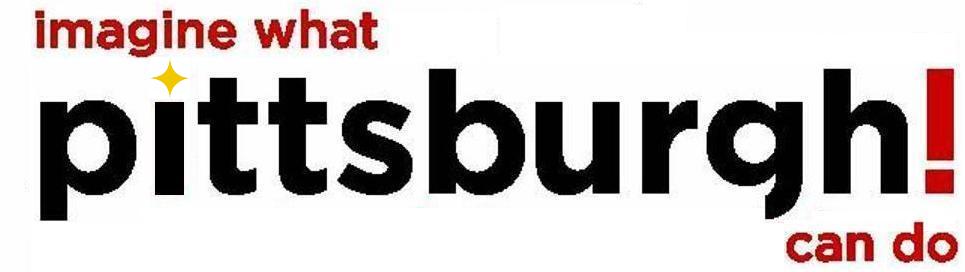 I'm sure you can do better. I have pretty primitive tools (all I have handy is MS Paint), and I'm a complete amateur. Help the Allegheny Conference brand Pittsburgh. "Imagine Pittsburgh" yourself, and post yours at your own blog, or send them to me, and I'll post them here.
Thursday, September 07, 2006
Ideation

I hadn't heard of "ideation" before, but I spotted this event -- The Sprout Fund's Idea Roundup -- while I was reading Angry Drunk Bureaucrat:
Engage Pittsburgh is a new initiative presented by the Sprout Fund to raise civic engagement and dialogue among Pittsburgh's creative, energized young people. The goal of the Idea Round Up is ideation- creating new solutions to nagging issues, making Pittsburgh the city you want it to be.
Sounds intriguing. If it works, that means that Pittsburgh could be the first American city to be saved by Zen.
WWBCT (What Would Bill Cowher Think)?
Dangerous Territory
I like the spirit of this post over at Antirust:
And in the Comments, "O," aka ADB chimes in:
I agree with Sam: It's an interesting thought experiment, and maybe it would be healthy for Pittsburghers to have an honest conversation about this. But playing with fire, they are. It will be interesting to read what turns up in the rest of the Comments.
So what is Pittsburgh's "critical modern moment"? And what impact does the relative stagnation of the population have on deciding that moment? Does it push it further back or further forward? I don't know. . . . I suppose this also works in the other direction. For newcomers: Is there any "defining" moment or development that you think prevents old-timers from seeing the future clearly? I know. I know. That is a snooty sort of thing to admit. But I am sure that a lot of new people feel that way. In fact, they say it all the time. "It's time for Pittsburgh to move beyond... X ... and begin Y."
Rather than speaking in generalities like "steel", are there actual moments that fit this description? For either newcomers or old timers?
Needlessly divisive? Perhaps. But maybe it's an interesting thought experiment.
And in the Comments, "O," aka ADB chimes in:
But more importantly, you can't really understand a Pittsburgher unless:
You understand and can explain why no one crosses rivers;
You have gotten into an argument with 3 other people over the best way to get somewhere;
You know why Dave Parker sucked;
You've dropped a "yinz" or a "dahn" or left out "to be" in a sentence;
Parts of your extended family still live in the same neighborhood as they did 50 years ago...
I agree with Sam: It's an interesting thought experiment, and maybe it would be healthy for Pittsburghers to have an honest conversation about this. But playing with fire, they are. It will be interesting to read what turns up in the rest of the Comments.
Tuesday, September 05, 2006
3 Rivers Venture Fair
The 3 Rivers Venture Fair is coming on September 20 and 21, sponsored by the Pittsburgh Venture Capital Association.
I took a look at the list of sponsors. Partly, I wanted to see who's buying and who's selling. There are a lot of each. Partly, I wanted to see which law firms are paying enough attention to ante up in the local tech game. All but one of the large local major firms are there. Several of the local offices of national firms are there. Virtually none of the locally-based mid-sized firms are there.
By the way, is it possible to do a business-oriented meeting in Pittsburgh *without* having a golf tournament?
I took a look at the list of sponsors. Partly, I wanted to see who's buying and who's selling. There are a lot of each. Partly, I wanted to see which law firms are paying enough attention to ante up in the local tech game. All but one of the large local major firms are there. Several of the local offices of national firms are there. Virtually none of the locally-based mid-sized firms are there.
By the way, is it possible to do a business-oriented meeting in Pittsburgh *without* having a golf tournament?
Monday, September 04, 2006
Subscribe to:
Posts (Atom)