Today's topic: Sports
There is only one organized sport in Pittsburgh: Steeler football.
Sure, there's a hockey team (the Penguins), and a baseball team (Pirates). There's a Division III soccer team (Riverhounds) and minor league baseball (Wild Things) nearby. Colleges (Panthers, Dukes, Tartans, and others) compete at various levels. I'm not going to try to be exhaustive; if you're a fan of a given sport, you probably already know what the team is and where to find it. I'll post later on recreational sports.
(One bit of trivia: Why do the Steelers, Penguins, and Pirates all wear black and gold? Because black-and-gold are the city's official colors.)
But even if you're not a sports fan, then you still need to know something about Steeler football. This region and this football team are matched culturally to a degree that may be unparalleled in the U.S. -- though Green Bay may be just as intense. Pittsburgh thinks of itself as honest, hard-working, loyal, and it likes to think that it avoids the flash and glamour of the big cities on the coasts. We're a working town. And we like to think that we see that ethos reflected on the football field. We have an ownership family (the Rooneys) that is as stable (since 1933!) and beloved as any ownership interest in all of professional sports. We have a coach (Cowher) who is a Pittsburgh native. (Unbelievably, the team has had only 2 head coaches in the last 35 years.) Many of the top players from the glory years of the 1970s adopted Pittsburgh as a place to live, and have remained members of the community. Today, that kind of loyalty and work ethic is still rewarded. Prance and dance and we'll run you out of town. Lower your head and take a beating for the team, and you will own the city.
I don't know what percentage of the region tunes in to watch and listen to games on Sunday afternoons in the Fall, but I do know that stores and roads are noticeably empty when the Steelers are on the field. (Local note: Lots of Steeler fans used to "mute" the TV commentary and watch the game while listening to Bill Hillgrove, Myron Cope, and Tunch Ilkin on the radio. With Myron's recent retirement, will we still listen to Bill and Tunch? My guess is -- yep.)
Even if you don't watch or listen, glance at the sports page from time to time, because you'll hear references in casual conversations to Cowher (the coach, and natives pronounce it "Caaher") and Hines (the man who catches the ball, not the condiment) and Big Ben (the man who throws the ball, not the clock) and Jerome, a.k.a. "The Bus," (the man who runs the ball, not the saint, or the vehicle for public transportation) and Duce (the other man who runs the ball, not the coupe) and Antwaan (the man who spins with the ball). There's Faneca (defined as "he who knocks your helmet off") and Kimo ("the immovable one") and Farrior ("the one who is all over the field") and Troy ("the other one who is all over the field, and who is faster than a speeding bullet").
I had a colleague whose wife is not a sports fan and who decided to master one Steeler-related phrase that she could toss knowledgeably into any sports conversation. She settled on "How about that Immaculate Reception?," which, as any Pittsburgher knows, is a sure clue that you're 30 years out of date. If you want a better phrase to sound like an insider this year, try "If Ben is going to carry the future of Pittsburgh on his shoulders, he should wear a helmet when he gets on his bike," or, "Ben's an adult. If he wants to ride without a helmet, he's entitled, and the law says he can." Take your pick.
Previous installments:
Welcome to Pittsburgh (Part IV)
Welcome to Pittsburgh (Part III)
Welcome to Pittsburgh (Part II)
Welcome to Pittsburgh (Part I)
Tuesday, June 28, 2005

Sunday, June 26, 2005
Welcome to Pittsburgh (Part IV)
Today's topic: Traffic and roads.
When we moved here, I looked around to decide where to live. A lot of people pointed out to me that Mt. Lebanon is a pleasant suburb with good schools. But when I mentioned possibly living out here to my prospective colleagues at Pitt, almost to a person I heard: Why would you want to live so far away? And have to drive so long to get to work?
Of course, Mt. Lebanon is roughly 10 miles from Oakland, and on an average day -- during rush hour, and including a bridge and a tunnel -- it takes me about 30 minutes to get from my front door to my office, including parking and walking.
So the first thing to know about Pittsburgh traffic is that on the whole, and by comparison to most major metropolitan areas, Pittsburgh doesn't have any. You want traffic -- go to Atlanta, or Washington, DC, or Los Angeles. For almost five years in the Bay Area, I had a 70 minute/40 mile commute each way, and that wasn't uncommon.
We do, however, have traffic jams and traffic problems, and of course Pittsburgh, like any metro region, has its share of driving idiosyncrasies.
One major cause of traffic jams is Pittsburgh's antiquated system of regional roadways. Pittsburgh never built a metro beltway. Instead, we have the Red and Blue and Green and Orange and Yellow belts, each one with an accompanying set of coded signs. You may be tempted to use these to get around. My advice: don't, unless you like sightseeing. The belt system is a charming curiosity that offers real transportation value to relatively few people, like the surviving inclines.
The interstate highways that do come into downtown are reasonably well-engineered up to a few miles from the Point, and then horribly engineered closer in. The heart of the whole thing, at the city-side anchorage of the Fort Pitt Bridge, is the worst-designed piece of highway engineering that I've ever seen in the U.S., outside of Boston. Then there are the short on-ramps to the Parkways -- where there is no time or space to do what I was taught to do: When entering a freeway, you simply drive on, get up to speed in the merge lane, and edge over. You do that here and you'll get killed.
In addition, until you figure out the best short cuts to get from one place to another on state highways and smaller roads, there are relatively few good alternatives to the interstates. So if there's an accident somewhere, then most of the time, and until you get a lot of confidence in your ability to feel your way via smaller roads, you're stuck. The corollary is that almost everyone here either inherits or learns a set of short cuts to get around and avoid congestion as much as possible. A lot of this is trial and error, though people are usually generous with sharing their tips -- the problem is that the tips usually involve landmark-specific directions, as in, "turn where the Isaly's used to be."
Of course, no one calls freeways "interstates." They are all "parkways" (as in the old Steven Wright quip, why do we drive on the parkway and park in the driveway?). There's the Parkway East (I-376, out through the Squirrel Hill Tunnels), the Parkway North (I-279, north beyond the Veterans' Bridge), and the Parkway West (I-279 through the Fort Pitt Tunnel and out to the Airport). There is no Parkway South.
There is rarely a straight route from point A to point B. Roads aren't laid out on a grid (unlike that other famous city on a bunch of hills, San Francisco); they weave around the hills and through the runs. When you arrive, you'll spend a lot of time exploring interesting parts of Pittsburgh because you're lost, or because you've taken one wrong turn and you're trying like hell to get back to where you made it.
Pittsburgh driving idiosyncrasies are too numerous to catalog. Here are some of my favorites:
-- Fear of tunnels: I've lived in places with tunnels, but I've never lived anywhere where people slow down at the entrance to a tunnel, on general principle. I've heard it said that the tunnels themselves are so dark that people aren't sure whether traffic is moving inside. I don't know. I do know that slow traffic at tunnel entrances is like the weather; everyone in Pittsburgh seems to talk about it, but no one does anything about it.
-- the Pittsburgh left: When the light turns from red to green, the driver in the left turn lane facing you may leap across the intersection before you and your colleagues get moving. Once you've lived here a little while, you learn to anticipate this, and it rarely causes problems. Almost anywhere else in the country, the maneuver would cause of thousands of accidents annually.
-- after you, Alphonse. No, after you, Gaston: Pittsburgh drivers are naturally, and some would say overly or even dangerously, courteous. If there's a line of cars on the Parkway heading across the Fort Pitt Bridge, and if you drive up near the head of the line and maneuver to nudge your way into the line, someone is apt to pause long enough to let you in. Also, drivers will stop in the middle of the road -- no stop sign, no red light, no Yield sign -- and let cars turn left in front of them. There's the sibling maneuver, the headlight flash from the ongoing car that says, "I'm going to let you turn in front on me, since you've been waiting to turn left." Again, in many parts of the country, the courteous driver (and possibly the turning vehicle) would be on the receiving end of loud honks, bumps, taps, fingers, yells, and even gun shots. Even here, it's not clear why courtesy favors the turning car over the trailing car, given the lack of danger to the former and the risk of collision with the latter. But it does. And it gives rise to:
-- the Pittsburgh wave: If someone lets you cut in, or lets to turn in front of them, you're supposed to give a little wave of acknowledgement and thanks. Failure to do this is a clear sign that you're from California.
-- Stop except right turn: Here and there, you will come to an intersection marked by a stop sign, but the stop sign is paired with a smaller sign that says: Except right turn. In other words, rather than the usual stop-then-right-turn, you just drive on by to the right. There's nothing wrong with this, except that I've never seen it anywhere else, and it's just weird.
And I haven't even mentioned the quality of the roads, or PennDOT, or public transit options (the subject of a future post), and/or other things that will probably show up in the Comments. Did I mention that Pittsburgh drivers aren't particularly friendly to pedestrians or bicyclists?
Finally, though I'm trying just to describe what I see, if my sweeping generalizations haven't irritated or offended native Pittsburghers yet, this one probably will: Pittsburghers, on the whole, drive slowly. Maybe it's the badly engineered or maintained roads. Maybe it's the large number of much older drivers. I don't know the reason. This isn't good or bad, but it's an adjustment. Californians are unaccountably fast drivers, though if you learn to drive out there you learn that it's possible to drive 75 miles an hour and more or less bumper to bumper with the cars in front of you and behind you -- and have the sense that the road is a relatively safe place. Bostonians are unaccountably fast, too, though they react less charitably to cars getting too close to them. I feel safe on the road up there because I'm certain that everyone else behind the wheel is insane, and they think that I am, too. Iowans are unaccountably fast, because they're used to speeding down rural blacktops at 90 miles an hour and dodging tractors and combines and deer and cows. My sense of safety out there comes from a peculiar fatalism, not trust in other drivers. (Maybe this is why my wife and I almost died laughing at the car/deer collision in The Straight Story, while no one else in the theater made a sound.) But I rarely feel safe on Pittsburgh roads; there isn't the fatalism of the Middle West nor the "we're all driving the same way" predictability of the coasts.
The bottom line is: Pittsburgh may be too small to have much traffic, but still: To drive in Pittsburgh is to learn patience behind the wheel.
Previous installments:
Welcome to Pittsburgh (Part III)
Welcome to Pittsburgh (Part II)
Welcome to Pittsburgh (Part I)
When we moved here, I looked around to decide where to live. A lot of people pointed out to me that Mt. Lebanon is a pleasant suburb with good schools. But when I mentioned possibly living out here to my prospective colleagues at Pitt, almost to a person I heard: Why would you want to live so far away? And have to drive so long to get to work?
Of course, Mt. Lebanon is roughly 10 miles from Oakland, and on an average day -- during rush hour, and including a bridge and a tunnel -- it takes me about 30 minutes to get from my front door to my office, including parking and walking.
So the first thing to know about Pittsburgh traffic is that on the whole, and by comparison to most major metropolitan areas, Pittsburgh doesn't have any. You want traffic -- go to Atlanta, or Washington, DC, or Los Angeles. For almost five years in the Bay Area, I had a 70 minute/40 mile commute each way, and that wasn't uncommon.
We do, however, have traffic jams and traffic problems, and of course Pittsburgh, like any metro region, has its share of driving idiosyncrasies.
One major cause of traffic jams is Pittsburgh's antiquated system of regional roadways. Pittsburgh never built a metro beltway. Instead, we have the Red and Blue and Green and Orange and Yellow belts, each one with an accompanying set of coded signs. You may be tempted to use these to get around. My advice: don't, unless you like sightseeing. The belt system is a charming curiosity that offers real transportation value to relatively few people, like the surviving inclines.
The interstate highways that do come into downtown are reasonably well-engineered up to a few miles from the Point, and then horribly engineered closer in. The heart of the whole thing, at the city-side anchorage of the Fort Pitt Bridge, is the worst-designed piece of highway engineering that I've ever seen in the U.S., outside of Boston. Then there are the short on-ramps to the Parkways -- where there is no time or space to do what I was taught to do: When entering a freeway, you simply drive on, get up to speed in the merge lane, and edge over. You do that here and you'll get killed.
In addition, until you figure out the best short cuts to get from one place to another on state highways and smaller roads, there are relatively few good alternatives to the interstates. So if there's an accident somewhere, then most of the time, and until you get a lot of confidence in your ability to feel your way via smaller roads, you're stuck. The corollary is that almost everyone here either inherits or learns a set of short cuts to get around and avoid congestion as much as possible. A lot of this is trial and error, though people are usually generous with sharing their tips -- the problem is that the tips usually involve landmark-specific directions, as in, "turn where the Isaly's used to be."
Of course, no one calls freeways "interstates." They are all "parkways" (as in the old Steven Wright quip, why do we drive on the parkway and park in the driveway?). There's the Parkway East (I-376, out through the Squirrel Hill Tunnels), the Parkway North (I-279, north beyond the Veterans' Bridge), and the Parkway West (I-279 through the Fort Pitt Tunnel and out to the Airport). There is no Parkway South.
There is rarely a straight route from point A to point B. Roads aren't laid out on a grid (unlike that other famous city on a bunch of hills, San Francisco); they weave around the hills and through the runs. When you arrive, you'll spend a lot of time exploring interesting parts of Pittsburgh because you're lost, or because you've taken one wrong turn and you're trying like hell to get back to where you made it.
Pittsburgh driving idiosyncrasies are too numerous to catalog. Here are some of my favorites:
-- Fear of tunnels: I've lived in places with tunnels, but I've never lived anywhere where people slow down at the entrance to a tunnel, on general principle. I've heard it said that the tunnels themselves are so dark that people aren't sure whether traffic is moving inside. I don't know. I do know that slow traffic at tunnel entrances is like the weather; everyone in Pittsburgh seems to talk about it, but no one does anything about it.
-- the Pittsburgh left: When the light turns from red to green, the driver in the left turn lane facing you may leap across the intersection before you and your colleagues get moving. Once you've lived here a little while, you learn to anticipate this, and it rarely causes problems. Almost anywhere else in the country, the maneuver would cause of thousands of accidents annually.
-- after you, Alphonse. No, after you, Gaston: Pittsburgh drivers are naturally, and some would say overly or even dangerously, courteous. If there's a line of cars on the Parkway heading across the Fort Pitt Bridge, and if you drive up near the head of the line and maneuver to nudge your way into the line, someone is apt to pause long enough to let you in. Also, drivers will stop in the middle of the road -- no stop sign, no red light, no Yield sign -- and let cars turn left in front of them. There's the sibling maneuver, the headlight flash from the ongoing car that says, "I'm going to let you turn in front on me, since you've been waiting to turn left." Again, in many parts of the country, the courteous driver (and possibly the turning vehicle) would be on the receiving end of loud honks, bumps, taps, fingers, yells, and even gun shots. Even here, it's not clear why courtesy favors the turning car over the trailing car, given the lack of danger to the former and the risk of collision with the latter. But it does. And it gives rise to:
-- the Pittsburgh wave: If someone lets you cut in, or lets to turn in front of them, you're supposed to give a little wave of acknowledgement and thanks. Failure to do this is a clear sign that you're from California.
-- Stop except right turn: Here and there, you will come to an intersection marked by a stop sign, but the stop sign is paired with a smaller sign that says: Except right turn. In other words, rather than the usual stop-then-right-turn, you just drive on by to the right. There's nothing wrong with this, except that I've never seen it anywhere else, and it's just weird.
And I haven't even mentioned the quality of the roads, or PennDOT, or public transit options (the subject of a future post), and/or other things that will probably show up in the Comments. Did I mention that Pittsburgh drivers aren't particularly friendly to pedestrians or bicyclists?
Finally, though I'm trying just to describe what I see, if my sweeping generalizations haven't irritated or offended native Pittsburghers yet, this one probably will: Pittsburghers, on the whole, drive slowly. Maybe it's the badly engineered or maintained roads. Maybe it's the large number of much older drivers. I don't know the reason. This isn't good or bad, but it's an adjustment. Californians are unaccountably fast drivers, though if you learn to drive out there you learn that it's possible to drive 75 miles an hour and more or less bumper to bumper with the cars in front of you and behind you -- and have the sense that the road is a relatively safe place. Bostonians are unaccountably fast, too, though they react less charitably to cars getting too close to them. I feel safe on the road up there because I'm certain that everyone else behind the wheel is insane, and they think that I am, too. Iowans are unaccountably fast, because they're used to speeding down rural blacktops at 90 miles an hour and dodging tractors and combines and deer and cows. My sense of safety out there comes from a peculiar fatalism, not trust in other drivers. (Maybe this is why my wife and I almost died laughing at the car/deer collision in The Straight Story, while no one else in the theater made a sound.) But I rarely feel safe on Pittsburgh roads; there isn't the fatalism of the Middle West nor the "we're all driving the same way" predictability of the coasts.
The bottom line is: Pittsburgh may be too small to have much traffic, but still: To drive in Pittsburgh is to learn patience behind the wheel.
Previous installments:
Welcome to Pittsburgh (Part III)
Welcome to Pittsburgh (Part II)
Welcome to Pittsburgh (Part I)
Friday, June 24, 2005
Welcome to Pittsburgh (Part III)
Today's topic: Crossing the Rivers
Growing up in California, I used to watch Steeler-Raider games played at something called "Three Rivers Stadium," but I had very little sense of Pittsburgh geography. But there are, of course, three major rivers here: The Allegheny, the Monongahela, and their product: the Ohio. The rivers are fundamental to Pittsburgh in all sorts of ways, but one of those is hidden to outsiders and reveals itself only gradually: People don't cross the rivers very often.
If you live in the North Hills, virtually all of your identity as a Pittsburgher -- recreation, socializing, casual errands, schools, church -- is tied up with doing things in the North Hills. Ditto for the South Hills; ditto for the City (the boundaries of the City don't correspond to the area between the Allegheny and the Mon, but they nearly do). If you live in the South Hills or North Hills, you rarely venture across the Ohio River to the other suburbs and only occasionally into the city, except to work. If you live in the City, you rarely venture into the North Hills or South Hills.
These are gross generalizations, and there are important exceptions, of course. Lots of people commute into the city from the North Hills and the South Hills. People will make a special effort to come downtown to watch the Steelers, or the Pirates. But when we moved to Pittsburgh, natives warned us: Pittsburghers don't cross the rivers. Bah, we said: we came from California, where people think nothing of driving a hour or more and across a major bridge or two just to have dinner or play a game of softball -- and then drive back afterward. (I also have a lot of family in rural parts of the Middle West, and driving from town to town for socializing, shopping, and recreation -- even county to county -- is pretty typical.) We'll have friends all over Pittsburgh, and we'll see them and they'll see us and everyone will be comfortable driving wherever we want to be. We needed an accountant and we found a good one in the North Hills (even though we live in the South Hills), and we thought: well, that's an ordinary thing to do.
Except that several years later, almost all of our friends are in the South Hills. We don't use that accountant any longer. We don't go to the North Hills and we don't really know our way around up there. Everything we need is close by in the South Hills (restaurants, parks, friends, shopping), and what we can't find here (better restaurants, more diverse shopping), we find in the City. If I venture east beyond Churchill, say, it's only because I'm on my way to the Turnpike; if I venture west beyond Bellevue, it's only because I'm showing off Sewickley to a visitor from out of town.
I'm not sure why this is. Maybe some of it has to do with deep, collective psychological responses to Pittsburgh's hilly geography. Some of it must have to do with our close-knit neighborhoods and communities, encouraging us to rely on nearby resources and in a variety of ways breeding suspicion of others. (High school football rivalries encourage this!) There's our mediocre transportation system (the subject of a future post), which doesn't make it easy to get from Point A to Point B anywhere in Pittsburgh and which must encourage us simply to stay put.
Whatever the reason, there is a lesson: When you pick a place to live in Pittsburgh, pick carefully, because other things being equal, your nearby community is going to frame an unexpected amount of your experience here.
Previous installments:
Welcome to Pittsburgh (Part II)
Welcome to Pittsburgh (Part I)
Growing up in California, I used to watch Steeler-Raider games played at something called "Three Rivers Stadium," but I had very little sense of Pittsburgh geography. But there are, of course, three major rivers here: The Allegheny, the Monongahela, and their product: the Ohio. The rivers are fundamental to Pittsburgh in all sorts of ways, but one of those is hidden to outsiders and reveals itself only gradually: People don't cross the rivers very often.
If you live in the North Hills, virtually all of your identity as a Pittsburgher -- recreation, socializing, casual errands, schools, church -- is tied up with doing things in the North Hills. Ditto for the South Hills; ditto for the City (the boundaries of the City don't correspond to the area between the Allegheny and the Mon, but they nearly do). If you live in the South Hills or North Hills, you rarely venture across the Ohio River to the other suburbs and only occasionally into the city, except to work. If you live in the City, you rarely venture into the North Hills or South Hills.
These are gross generalizations, and there are important exceptions, of course. Lots of people commute into the city from the North Hills and the South Hills. People will make a special effort to come downtown to watch the Steelers, or the Pirates. But when we moved to Pittsburgh, natives warned us: Pittsburghers don't cross the rivers. Bah, we said: we came from California, where people think nothing of driving a hour or more and across a major bridge or two just to have dinner or play a game of softball -- and then drive back afterward. (I also have a lot of family in rural parts of the Middle West, and driving from town to town for socializing, shopping, and recreation -- even county to county -- is pretty typical.) We'll have friends all over Pittsburgh, and we'll see them and they'll see us and everyone will be comfortable driving wherever we want to be. We needed an accountant and we found a good one in the North Hills (even though we live in the South Hills), and we thought: well, that's an ordinary thing to do.
Except that several years later, almost all of our friends are in the South Hills. We don't use that accountant any longer. We don't go to the North Hills and we don't really know our way around up there. Everything we need is close by in the South Hills (restaurants, parks, friends, shopping), and what we can't find here (better restaurants, more diverse shopping), we find in the City. If I venture east beyond Churchill, say, it's only because I'm on my way to the Turnpike; if I venture west beyond Bellevue, it's only because I'm showing off Sewickley to a visitor from out of town.
I'm not sure why this is. Maybe some of it has to do with deep, collective psychological responses to Pittsburgh's hilly geography. Some of it must have to do with our close-knit neighborhoods and communities, encouraging us to rely on nearby resources and in a variety of ways breeding suspicion of others. (High school football rivalries encourage this!) There's our mediocre transportation system (the subject of a future post), which doesn't make it easy to get from Point A to Point B anywhere in Pittsburgh and which must encourage us simply to stay put.
Whatever the reason, there is a lesson: When you pick a place to live in Pittsburgh, pick carefully, because other things being equal, your nearby community is going to frame an unexpected amount of your experience here.
Previous installments:
Welcome to Pittsburgh (Part II)
Welcome to Pittsburgh (Part I)
Thursday, June 23, 2005
Welcome to Pittsburgh (Part II)
Today's topic: the food.
There was a time, in the not-so-distant past, that eating out in Pittsburgh was characterized primarily by huge portions of mediocre food. Eating in wasn't much better; when we arrived in town, we asked around for the best produce and were uniformly directed to the Strip -- where we found produce that was no better than what we could find in our local Safeway store in California.
But things have changed rapidly, and for the better. Over the last few years, Pittsburgh has grown enough competent mid-range (and a very few high-end) restaurants that people can have online debates about their merits.
Take, for example, these micro-reviews (many of which I disagree with -- If the State of California could sue a restaurant for abusing the reputation of a wonderful region, then it should go after Monterey Bay, which is just awful; Vivo is very good but very uneven; I've been to DeLuca's more than once, and I just don't get it; Caruso's for pizza? Are you kidding?; Mad Mex is pleasant but it isn't even Mexican, let alone the best Mexican in Pittsburgh).
Or, try this post over at Tea Leaves (dead-on-balls-accurate for items 1 - 3).
I took a stab at prompting discussion, here.
Peter Machamer's wonderfully idiosyncratic Eating, Drinking, and Living Well in Pittsburgh is still available, but get your copy now or help Peter find a publisher, quick.
Eating in? High quality produce is available via farmer's markets throughout the region, in a Whole Foods Store in East Liberty (with another one on the way in the South Hills), and to East Enders at the East End Food Coop (since 1977). Excellent meats, cheeses, pastas, and breads are available at Whole Foods and in the suburbs at McGinnis Sisters and John McGinnis (Route 88 in Castle Shannon). The produce I've seen recently in the Strip has certainly improved, and in the Strip you can always find excellent fish and meat, bread and produce, and lots of cheese. The point is that you don't have to go down there to find it. The arrival of Whole Foods seems to have helped across the board; even if you don't shop there (and it can be expensive), other markets, both large and small, have improved the quality and variety of what they sell. Even the suburban Giant Eagle supermarkets now stock some organic stuff.
Local food festivals cover a variety of national and ethnic cuisines in wonderful fashion -- if there's a schedule of all the Greek food festivals available on-line somewhere, please let me know! Staples for Indian, Asian, and Greek cooking, and probably for other cuisines that I don't know about, are easily available.
There are some local food traditions that I'll never understand -- cookie tables at weddings; "wedding soup" (years ago, on my first visit to an Eat n' Park, I asked the server what that was and she replied, "you must not be from around here"; french-fries-inside-the-sandwich -- but these are distinctively Pittsburgh, things that remind you that this isn't a foodie's New York, and it neither will be, nor wants to be. But there is plenty to keep your stomach happy.
There was a time, in the not-so-distant past, that eating out in Pittsburgh was characterized primarily by huge portions of mediocre food. Eating in wasn't much better; when we arrived in town, we asked around for the best produce and were uniformly directed to the Strip -- where we found produce that was no better than what we could find in our local Safeway store in California.
But things have changed rapidly, and for the better. Over the last few years, Pittsburgh has grown enough competent mid-range (and a very few high-end) restaurants that people can have online debates about their merits.
Take, for example, these micro-reviews (many of which I disagree with -- If the State of California could sue a restaurant for abusing the reputation of a wonderful region, then it should go after Monterey Bay, which is just awful; Vivo is very good but very uneven; I've been to DeLuca's more than once, and I just don't get it; Caruso's for pizza? Are you kidding?; Mad Mex is pleasant but it isn't even Mexican, let alone the best Mexican in Pittsburgh).
Or, try this post over at Tea Leaves (dead-on-balls-accurate for items 1 - 3).
I took a stab at prompting discussion, here.
Peter Machamer's wonderfully idiosyncratic Eating, Drinking, and Living Well in Pittsburgh is still available, but get your copy now or help Peter find a publisher, quick.
Eating in? High quality produce is available via farmer's markets throughout the region, in a Whole Foods Store in East Liberty (with another one on the way in the South Hills), and to East Enders at the East End Food Coop (since 1977). Excellent meats, cheeses, pastas, and breads are available at Whole Foods and in the suburbs at McGinnis Sisters and John McGinnis (Route 88 in Castle Shannon). The produce I've seen recently in the Strip has certainly improved, and in the Strip you can always find excellent fish and meat, bread and produce, and lots of cheese. The point is that you don't have to go down there to find it. The arrival of Whole Foods seems to have helped across the board; even if you don't shop there (and it can be expensive), other markets, both large and small, have improved the quality and variety of what they sell. Even the suburban Giant Eagle supermarkets now stock some organic stuff.
Local food festivals cover a variety of national and ethnic cuisines in wonderful fashion -- if there's a schedule of all the Greek food festivals available on-line somewhere, please let me know! Staples for Indian, Asian, and Greek cooking, and probably for other cuisines that I don't know about, are easily available.
There are some local food traditions that I'll never understand -- cookie tables at weddings; "wedding soup" (years ago, on my first visit to an Eat n' Park, I asked the server what that was and she replied, "you must not be from around here"; french-fries-inside-the-sandwich -- but these are distinctively Pittsburgh, things that remind you that this isn't a foodie's New York, and it neither will be, nor wants to be. But there is plenty to keep your stomach happy.
Hot Dogma
I decide to stop blogging the news, and the news decides to bite me in the bun. So to speak. I'm referring, of course, to today's column by Brian O'Neill, reporting that the folks at Hot Dogma downtown have received a letter demanding that they change the name of the shop. "Hot Dogma" allegedly infringes the trademark (well, service mark, to be precise) of South Florida's Dogma Grill.
How could a Pittsburgh restaurant offend a Miami business? The Dogma Grill does, in fact, have a federally registered service mark, No. 2786127 to be precise, for the mark: "DOGMA GRILL A FRANK PHILOSOPHY." That mark was registered on November 25, 2003, before Hot Dogma opened for business. A federal registration gives its owner national rights to the name over anyone who comes later. In trademark law, priority isn't everything, but it counts for a lot.
But there's more. Priority isn't the only thing. The real key is consumer confusion. Dogma Grill has a point only if consumers are likely to be confused about the source of the dogs. Will Pittsburghers think that Hot Dogma's dogs are produced by Dogma Grill? What if those Pittsburghers have visited Miami? Live in Miami part time? What about South Floridians visiting Pittsburgh who happen to stop by Hot Dogma? This gets complicated.
I don't mean to get on Hot Dogma's case; in fact, I agree with Brian that Dogma Grill is being needlessly dogmatic about the whole thing. But Brian writes:
Hold on there: The idea that a trademark owner is required to challenge people who use similar name is a myth. Nothing in trademark law requires that Dogma Grill send a cease-and-desist letter to Hot Dogma. Sending letters like this is known as "policing" the mark. Trademark owners choose to send them because they're afraid that failure to "police" the mark would lead to the conclusion that the mark had been "abandoned," and then they would be permanently out of luck. But courts very, very rarely go down that path. (For law geeks, see, for example, the opinions in Wallpaper Mfrs., Ltd. v. Crown Wallcovering Corp., 680 F.2d 755, 766 (CCPA 1982) and U. S. Jaycees v. Philadelphia Jaycees, 639 F.2d 134 (3d Cir. 1981).) So long as Dogma Grill stays in business, and so long as Hot Dogma remains just the plucky little start up that it is, Dogma Grill would be just fine, in trademark terms, if it decided to back off. If "Dogma" for (hot) dogs starts popping up in all kinds of other places, then -- and only then -- will things change. Maybe.
How could a Pittsburgh restaurant offend a Miami business? The Dogma Grill does, in fact, have a federally registered service mark, No. 2786127 to be precise, for the mark: "DOGMA GRILL A FRANK PHILOSOPHY." That mark was registered on November 25, 2003, before Hot Dogma opened for business. A federal registration gives its owner national rights to the name over anyone who comes later. In trademark law, priority isn't everything, but it counts for a lot.
But there's more. Priority isn't the only thing. The real key is consumer confusion. Dogma Grill has a point only if consumers are likely to be confused about the source of the dogs. Will Pittsburghers think that Hot Dogma's dogs are produced by Dogma Grill? What if those Pittsburghers have visited Miami? Live in Miami part time? What about South Floridians visiting Pittsburgh who happen to stop by Hot Dogma? This gets complicated.
I don't mean to get on Hot Dogma's case; in fact, I agree with Brian that Dogma Grill is being needlessly dogmatic about the whole thing. But Brian writes:
I expect his letter is boilerplate stuff. If the holder of a trademark finds someone using a similar name, he is compelled to defend the mark. A person who expects to hold sole possession of "dogma'' must be very dogmatic indeed.
Hold on there: The idea that a trademark owner is required to challenge people who use similar name is a myth. Nothing in trademark law requires that Dogma Grill send a cease-and-desist letter to Hot Dogma. Sending letters like this is known as "policing" the mark. Trademark owners choose to send them because they're afraid that failure to "police" the mark would lead to the conclusion that the mark had been "abandoned," and then they would be permanently out of luck. But courts very, very rarely go down that path. (For law geeks, see, for example, the opinions in Wallpaper Mfrs., Ltd. v. Crown Wallcovering Corp., 680 F.2d 755, 766 (CCPA 1982) and U. S. Jaycees v. Philadelphia Jaycees, 639 F.2d 134 (3d Cir. 1981).) So long as Dogma Grill stays in business, and so long as Hot Dogma remains just the plucky little start up that it is, Dogma Grill would be just fine, in trademark terms, if it decided to back off. If "Dogma" for (hot) dogs starts popping up in all kinds of other places, then -- and only then -- will things change. Maybe.
Wednesday, June 22, 2005
Welcome to Pittsburgh (Part I)
Pittsburgh doesn't have a large population of newcomers, but non-natives do move here. Because I'm tired of blogging about the news, and because others do that better and more thoroughly than I can, this post kicks off an occasional series: What Newcomers Should Know About Pittsburgh.
Today's Topic: Tradition
One of the great strengths of Pittsburgh, and of Western Pennsylvania as a whole, is that it is suffused with an extraordinary sense of its history. A century ago, Pittsburgh was a world-beating industrial community. The thousands of people drawn to the city from abroad created vibrant populations of new Americans. The captains of Pittsburgh industry amassed extraordinary wealth, much of which was used to develop and re-develop the city's infrastructure and cultural resources and to support Pittsburgh's political establishment. Importantly, immigrant populations that served as Pittsburgh's working backbone established rich, dynamic neighborhood-based communities, and an ethos of pride, modesty, and self-reliance. In many ways large and small, Pittsburgh set the standard nationally for enlightened government, thriving local communities, and honest and respectful individualism.
Now that's a highly simplified and romanticized account, but I'll let it stand. What I want to note is this: While large-scale manufacturing has largely disappeared, the immigrant populations have aged, and local government is often less than enlightened, the senses of community and individual pride, modesty, and self-reliance that were established a century ago remain powerful today, among all those born and raised in Pittsburgh and especially among those with more than one generation based here. Pittsburgh's historical industrial wealth continues to be reflected in support for culture and infrastructure. The whole town or neighborhood turns out on Friday night, and on Sunday, we run first, pass second, and stick to the fundamentals on defense. Tradition counts for a lot in Pittsburgh, and it counts for a lot because it reflects pride in what the region, city, and community once was, sometimes still is, and what it hopes again to be, someday. Moving to Pittsburgh and succeeding -- in business, in school, in the community -- means learning about Pittsburgh's traditions and the history that gave rise to them, and then respecting and working with tradition as the city changes.
Today's Topic: Tradition
One of the great strengths of Pittsburgh, and of Western Pennsylvania as a whole, is that it is suffused with an extraordinary sense of its history. A century ago, Pittsburgh was a world-beating industrial community. The thousands of people drawn to the city from abroad created vibrant populations of new Americans. The captains of Pittsburgh industry amassed extraordinary wealth, much of which was used to develop and re-develop the city's infrastructure and cultural resources and to support Pittsburgh's political establishment. Importantly, immigrant populations that served as Pittsburgh's working backbone established rich, dynamic neighborhood-based communities, and an ethos of pride, modesty, and self-reliance. In many ways large and small, Pittsburgh set the standard nationally for enlightened government, thriving local communities, and honest and respectful individualism.
Now that's a highly simplified and romanticized account, but I'll let it stand. What I want to note is this: While large-scale manufacturing has largely disappeared, the immigrant populations have aged, and local government is often less than enlightened, the senses of community and individual pride, modesty, and self-reliance that were established a century ago remain powerful today, among all those born and raised in Pittsburgh and especially among those with more than one generation based here. Pittsburgh's historical industrial wealth continues to be reflected in support for culture and infrastructure. The whole town or neighborhood turns out on Friday night, and on Sunday, we run first, pass second, and stick to the fundamentals on defense. Tradition counts for a lot in Pittsburgh, and it counts for a lot because it reflects pride in what the region, city, and community once was, sometimes still is, and what it hopes again to be, someday. Moving to Pittsburgh and succeeding -- in business, in school, in the community -- means learning about Pittsburgh's traditions and the history that gave rise to them, and then respecting and working with tradition as the city changes.
Monday, June 20, 2005
Post-Father's Day
The whole family enjoyed a tremendous Father's Day yesterday with our annual pilgrimage to Kennywood. The weather was gorgeous, and the park was in beautiful shape. Running only one car on the Phantom's Revenge kept the line longer than it needed to be, but we still got two rides in, plus two on the 'Bolt, and it was warm enough to do the Pittsburgh Plunge and the Ragin' Rapids back to back.
Enjoy the summer solstice today.
Enjoy the summer solstice today.
Wednesday, June 15, 2005
Blog Survey at MIT
The MIT Media Lab is conducting a survey of weblogs, to support research on how the blogosphere works (my words, not theirs). Check it out.
Progressive Leadership
An email from Jon Delano this morning brings news of this weekend's leadership program organized by the Center for Progressive Leadership and hosted by Carnegie Mellon University. It looks like there may still be time to register for Pennsylvania Political Leaders Springboard Training.
Bloomsday 2005
Tomorrow is Bloomsday, and thanks to some intrepid research by Erik K., here is the schedule of Pittsburgh Bloomsday events.
Is There a Slogan Here Somewhere?
Continuing my recent preoccupation with rankings of Pittsburgh and Pennsylvania, meaningless and otherwise, today's news brings the following:
Looking at housing and transportation costs -- and particularly housing costs -- it is comparatively inexpensive to live here. Pittsburgh ranks 28 out of 28 MSAs surveyed. Post-Gazette coverage here; Trib coverage here.
We have something of an arts community. Pittsburgh is 10 out of 25 "mid-sized cities" (100,000 - 499,000 population) ranked by AmericanStyle magazine in a readers' poll of Top Arts Destinations. Post-Gazette coverage here.
Looking at housing and transportation costs -- and particularly housing costs -- it is comparatively inexpensive to live here. Pittsburgh ranks 28 out of 28 MSAs surveyed. Post-Gazette coverage here; Trib coverage here.
We have something of an arts community. Pittsburgh is 10 out of 25 "mid-sized cities" (100,000 - 499,000 population) ranked by AmericanStyle magazine in a readers' poll of Top Arts Destinations. Post-Gazette coverage here.
Tuesday, June 14, 2005
Pennsylvania: Smart
I'm skeptical of the methodology, as we all should be, but I'll take the results:
Pennsylvania ranks #9 in this listing of the smartest states.
Pennsylvania ranks #9 in this listing of the smartest states.
Act 47 v. the ICA
So the legislature may pull the plug on the Intergovernmental Cooperation Authority, leaving Pittsburgh in the hands of the Governor's Act 47 recovery team? The citizenry will undoubtedly emit its usual collective yawn over this development (today is Flag Day, after all, so there are more compelling things to attend to), but the death of the ICA would be an interesting thing in itself. Would it signify:
-- the triumph of the Governor in the hallways of power in Harrisburg?
-- the triumph of the executive branch bureaucracy in Harrisburg?
-- the capitulation of suburban Pittsburgh legislators to the Governor's agenda for Pittsburgh?
-- a decision by suburban Pittsburgh legislators to write off the City, and that funding the ICA is throwing good money after bad?
-- clearing the decks for a city/county merger?
-- rearranging the deck chairs on a sinking ship?
-- all of the above?
-- none of the above?
-- the triumph of the Governor in the hallways of power in Harrisburg?
-- the triumph of the executive branch bureaucracy in Harrisburg?
-- the capitulation of suburban Pittsburgh legislators to the Governor's agenda for Pittsburgh?
-- a decision by suburban Pittsburgh legislators to write off the City, and that funding the ICA is throwing good money after bad?
-- clearing the decks for a city/county merger?
-- rearranging the deck chairs on a sinking ship?
-- all of the above?
-- none of the above?
Friday, June 10, 2005
42
Officer Jim, guest blogging at Tube City, weighs in on the recent news about federal support for the extension of the T under the Allegheny River.
The controversy over extending the T is kind of old news, and no offense to Officer Jim. Because as he ends his guest stint, he deserves all kinds of applause for referring to the Hitchhiker's Guide in the title to the post, and not caring whether or not people get it. Make no mistake: In the age of RSS, the title of a post can be a make-or-break-it-decision. I'll guess that the blogosphere is a little more H2G2-hip than the population at large, but there will still be a group of folks who say, "Wha?" Those of us who get it salute you for your ballsiness!
The controversy over extending the T is kind of old news, and no offense to Officer Jim. Because as he ends his guest stint, he deserves all kinds of applause for referring to the Hitchhiker's Guide in the title to the post, and not caring whether or not people get it. Make no mistake: In the age of RSS, the title of a post can be a make-or-break-it-decision. I'll guess that the blogosphere is a little more H2G2-hip than the population at large, but there will still be a group of folks who say, "Wha?" Those of us who get it salute you for your ballsiness!
Is Pittsburgh a Dirty City?
Does this data mean anything?
The Reader's Digest is publishing a list of the cleanest (large) cities in the United States. The good news: Pittsburgh made the list. The bad news: We're third from worst.
The Reader's Digest is publishing a list of the cleanest (large) cities in the United States. The good news: Pittsburgh made the list. The bad news: We're third from worst.
Athletes
Have you been to any Senior Games events? Met any of the athletes? I happened to be at the Phipps Conservatory for lunch yesterday, and there were athletes (both women, as it happened) at two of the adjacent tables. One was wearing her gold medal! She looked fit, and proud. It's both hot and cool in Pittsburgh today.
Cope
Dave Copeland, formerly of the Trib and an early Pittsburgh blogger, emailed me to note a new venture: Lawyers and Business Executives in the News, which describes itself as "the first blog devoted to legal issues of national significance and public interest."
Given the hundreds of law-and-policy blogs out there, I don't know what to make of that statement. But hats off to Dave, who has returned to Boston, for having made a courageous career decision and apparently thriving.
Given the hundreds of law-and-policy blogs out there, I don't know what to make of that statement. But hats off to Dave, who has returned to Boston, for having made a courageous career decision and apparently thriving.
Wednesday, June 08, 2005
Google Fallingwater
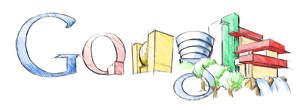
In honor of the fact that today (June 8) is Frank Lloyd Wright's birthday, the Google logo includes a nifty collage of drawings of Wright buildings, the most recognizable of which is, of course, Fallingwater.
Innovator's Dilemma
In the spirit of writing "Richard Florida" and stepping back to watch the fireworks in the comments, this morning I might write "Clayton Christensen," who spoke yesterday at the PTC's "Innovation Day." The P-G ran a nice story on his talk. The Trib was there, too.
But I don't know whether Pittsburghers are as familiar with Christensen's work, since (unlike Rich Florida), he's a pretty modest, suburban guy. Years ago, when I lived in the Boston suburbs, I met him a couple of times -- he was the Cubmaster of my son's Cub Scout pack. If I were to write simply "Clayton Christensen," I might get comments that read, "He's a real Boy Scout." So I'll explain a bit.
Personalities aside, the important difference is that Christensen sees innovation and creativity in structural terms. He's talking about firms, not about regional development, so you have to do a bit of work to see whether any of the argument tracks in broad terms. But at the firm level, Christensen has some persuasive evidence showing that success over the long term requires giving up the notion that a firm should focus only on its core competencies. Over time, that focus tends to lead firms to neglect meaningful innovation in the commodity end of the business (tweaks OK; radical change bad) and to focus investment in up-market trends, in pursuit of higher margins. Internal innovations that compete with the existing commodity business tend to be ignored. To the firm, this is "disruptive" innovation, because it disrupts the firm's basic mission. Ignoring it is the rational thing to do. But along come lower-end, lower-margin competitors that are happy to rely on "disruptive" solutions, and they gobble up the commodity business. Poof -- there goes the company that rationally ignored the disruption.
Christensen's solution is to encourage firms to set innovation free, by separating it structurally from the "ordinary" operations of the company. This doesn't mean putting the creative minds in a conference room somewhere; it means taking a whole business unit, creative minds and accountants and all, and giving them independence from the day-to-day commodity business. In the book, his best example isn't Southwest Airlines (a disruptive company that captured a low-end market that the major carriers couldn't, or wouldn't, understand), though Southwest was part of yesterday's talk). His key example is Hewlett-Packard, which never would have gotten its printer business off the ground if the printer group had been housed at company HQ in Palo Alto. For many years, HP was an intrumentation company, and the printer business isn't instruments.
This isn't thinking outside the box. It's building different boxes, and putting them in different places. Successful innovation requires structural support for "disruptive" development. Sometimes, the firm needs to look for innovations that might cannibalize its existing core. Risk-taking, but risk-taking within a defined structure.
What does all of this mean, if anything, for regional development? I'll leave that mostly to you all -- though intuitively, it strikes me as reinforcement for the idea that central (regional economic) planning designed to find "the next big thing" for this or any other region is unlikely to score a home run. It also strikes me as sounding a note of caution about the reductionist version of Floridianism ("Find creative people and good things will happen."). Note to Pittsburgh Technology Council members, and to enterprises of all sizes and ages around Pittsburgh: Clay Christensen is more than willing to work with you one on one.
But I don't know whether Pittsburghers are as familiar with Christensen's work, since (unlike Rich Florida), he's a pretty modest, suburban guy. Years ago, when I lived in the Boston suburbs, I met him a couple of times -- he was the Cubmaster of my son's Cub Scout pack. If I were to write simply "Clayton Christensen," I might get comments that read, "He's a real Boy Scout." So I'll explain a bit.
Personalities aside, the important difference is that Christensen sees innovation and creativity in structural terms. He's talking about firms, not about regional development, so you have to do a bit of work to see whether any of the argument tracks in broad terms. But at the firm level, Christensen has some persuasive evidence showing that success over the long term requires giving up the notion that a firm should focus only on its core competencies. Over time, that focus tends to lead firms to neglect meaningful innovation in the commodity end of the business (tweaks OK; radical change bad) and to focus investment in up-market trends, in pursuit of higher margins. Internal innovations that compete with the existing commodity business tend to be ignored. To the firm, this is "disruptive" innovation, because it disrupts the firm's basic mission. Ignoring it is the rational thing to do. But along come lower-end, lower-margin competitors that are happy to rely on "disruptive" solutions, and they gobble up the commodity business. Poof -- there goes the company that rationally ignored the disruption.
Christensen's solution is to encourage firms to set innovation free, by separating it structurally from the "ordinary" operations of the company. This doesn't mean putting the creative minds in a conference room somewhere; it means taking a whole business unit, creative minds and accountants and all, and giving them independence from the day-to-day commodity business. In the book, his best example isn't Southwest Airlines (a disruptive company that captured a low-end market that the major carriers couldn't, or wouldn't, understand), though Southwest was part of yesterday's talk). His key example is Hewlett-Packard, which never would have gotten its printer business off the ground if the printer group had been housed at company HQ in Palo Alto. For many years, HP was an intrumentation company, and the printer business isn't instruments.
This isn't thinking outside the box. It's building different boxes, and putting them in different places. Successful innovation requires structural support for "disruptive" development. Sometimes, the firm needs to look for innovations that might cannibalize its existing core. Risk-taking, but risk-taking within a defined structure.
What does all of this mean, if anything, for regional development? I'll leave that mostly to you all -- though intuitively, it strikes me as reinforcement for the idea that central (regional economic) planning designed to find "the next big thing" for this or any other region is unlikely to score a home run. It also strikes me as sounding a note of caution about the reductionist version of Floridianism ("Find creative people and good things will happen."). Note to Pittsburgh Technology Council members, and to enterprises of all sizes and ages around Pittsburgh: Clay Christensen is more than willing to work with you one on one.
Innovation Day
I find it a little strange that the Pittsburgh Technology Council's "Innovation Day" yesterday featured not a single speaker or panel on legal protection for innovation. Innovate away, but if someone steals your idea . . . .
Tuesday, June 07, 2005
High Quality Cheap Eats
In the comments below, Sabrina wonders, more or less, about high quality, reasonably priced restaurants in and around Pittsburgh.
So: let's hear it. What are the best reasonably-priced places to eat in the Pittsblog-reading region? For now, I'll define "reasonably-priced" as $10 or less per person, but depending on the comments, I can revise that up or down.
Rules: 1. No chains. 2. Apply the same standards that a reviewer would apply to any restaurant -- quality and consistency of food, service, and atmosphere. 3. Restaurants on either of the Pittsburgh Magazine lists are eligible, subject to Rules 1 and 2.
So: let's hear it. What are the best reasonably-priced places to eat in the Pittsblog-reading region? For now, I'll define "reasonably-priced" as $10 or less per person, but depending on the comments, I can revise that up or down.
Rules: 1. No chains. 2. Apply the same standards that a reviewer would apply to any restaurant -- quality and consistency of food, service, and atmosphere. 3. Restaurants on either of the Pittsburgh Magazine lists are eligible, subject to Rules 1 and 2.
PA Travel Blogs
CNN carries a Reuters report on the PA Tourism Office hiring people to travel around the Commonwealth and blog about their experiences, in order to promote tourism here. All of the blogs are at VisitPA.com.
I assume that these are real people, even though some of the descriptions make the whole project sound like a parody of reality TV -- and not at all like something that's part of the blogosphere. There's Elliot, the outdoor adventurer who's biking in Eastern PA; Tamara and Michael, hipster roadtrippers also wandering around Eastern PA; Tom, on his hog in and around the Laurel Highlands; Preethi & Manisha, "culture vultures" from Pittsburgh who are hitting some of the tonier "hot" spots around town; Robert the history buff in Gettysburg; and the Kruger family of Pittsburgh, which went to Erie.
The PA Tourism Office is missing a great opportunity here: Instead of hiring people, paying them to travel, and inventing blogs that are hard to find and hard to read (apparently no one up there has heard of RSS), the Office could hire a single person to monitor RSS feeds for some of the thousands of blogs that already exist in the Commonwealth. There's no need to manufacture enthusiasm. Show off some of the natural energy of the state.
I assume that these are real people, even though some of the descriptions make the whole project sound like a parody of reality TV -- and not at all like something that's part of the blogosphere. There's Elliot, the outdoor adventurer who's biking in Eastern PA; Tamara and Michael, hipster roadtrippers also wandering around Eastern PA; Tom, on his hog in and around the Laurel Highlands; Preethi & Manisha, "culture vultures" from Pittsburgh who are hitting some of the tonier "hot" spots around town; Robert the history buff in Gettysburg; and the Kruger family of Pittsburgh, which went to Erie.
The PA Tourism Office is missing a great opportunity here: Instead of hiring people, paying them to travel, and inventing blogs that are hard to find and hard to read (apparently no one up there has heard of RSS), the Office could hire a single person to monitor RSS feeds for some of the thousands of blogs that already exist in the Commonwealth. There's no need to manufacture enthusiasm. Show off some of the natural energy of the state.
Monday, June 06, 2005
Best Pgh Restaurants
Pittsburgh Magazine's list of the Best Restaurants of Pittsburgh is finally online. Nothing leaps out at me as surprising by inclusion or omission (though if you can say "Big Burrito" you'll cover a lot of ground here). But what do I know?
What's missing? And what's riding on reputation?
UPDATE (10 p.m. 6/6): A thousand apologies . . . I looked at this list (chefs' favorite dishes) instead of clicking through to this, which is the readers' poll that so rightly set off peterb (see comments). In the context of that second list (the poll), my questions make no sense.
So let me re-ask the questions: Looking at the restaurants on the "chef's favorite dishes" list, what's missing, and what's riding on reputation?
What's missing? And what's riding on reputation?
UPDATE (10 p.m. 6/6): A thousand apologies . . . I looked at this list (chefs' favorite dishes) instead of clicking through to this, which is the readers' poll that so rightly set off peterb (see comments). In the context of that second list (the poll), my questions make no sense.
So let me re-ask the questions: Looking at the restaurants on the "chef's favorite dishes" list, what's missing, and what's riding on reputation?
P-G on Technology Entrepreneurship
Broken record department: The Post-Gazette has a seemingly endless appetite for opinion pieces and features about the failures of tech entrepreneurship in the region.
The opinion piece, by a local lawyer, demonstrates a nice awareness of some basic regional economic development literature but no knowledge of the work most relevant to his own place in the hierarchy -- Mark Suchman's research on the sociology of high technology law firms in the Silicon Valley. Corporate lawyers in successful high tech markets operate as aggressive information brokers, placing investors with entrepreneurs, and vice versa. Looking for reasons behind Pittsburgh's failure to generate more small and mid-size technology startups? Start looking at the relatively placid waters of Pittsburgh's legal market.
The feature, on the next local high tech stars, focuses on a handful of firms:
I blogged about Renal Solutions nine months ago, so that company is still looking to break out of the pack. But is looking for the next "star" company the right approach -- even in the business media? Compare Silicon Valley -- which is entrepreneur-oriented as much as firm-oriented.
The Valley is an ugly place in a lot of ways, but since the demise of its original twin stalwarts -- agriculture and defense -- it's never tried to strategize finding the next big regional thing. The Valley has placed a lot of bets, and big things have happened.
The opinion piece, by a local lawyer, demonstrates a nice awareness of some basic regional economic development literature but no knowledge of the work most relevant to his own place in the hierarchy -- Mark Suchman's research on the sociology of high technology law firms in the Silicon Valley. Corporate lawyers in successful high tech markets operate as aggressive information brokers, placing investors with entrepreneurs, and vice versa. Looking for reasons behind Pittsburgh's failure to generate more small and mid-size technology startups? Start looking at the relatively placid waters of Pittsburgh's legal market.
The feature, on the next local high tech stars, focuses on a handful of firms:
Young companies cited by local tech insiders as being well on their way to becoming stars include Renal Solutions Inc., of Marshall, Akustica Inc., LogicLibrary Inc. and Precision Therapeutics Inc., all of the South Side, Plextronics Inc., of Harmarville, Downtown's TimeSys Corp. and Apangea Learning Inc., of Indiana, Pa.
I blogged about Renal Solutions nine months ago, so that company is still looking to break out of the pack. But is looking for the next "star" company the right approach -- even in the business media? Compare Silicon Valley -- which is entrepreneur-oriented as much as firm-oriented.
"This is not a one-industry town like Detroit or Pittsburgh were," says Andy Rappaport, who, as a partner at August Capital, is one of the thousands of venture capitalists who trawl the valley in search of companies that might provide a big-bang payoff. "This is a startup town. Our core competency here isn't chips, or networking products, or software. The culture is built around the creation of startups."
The Valley is an ugly place in a lot of ways, but since the demise of its original twin stalwarts -- agriculture and defense -- it's never tried to strategize finding the next big regional thing. The Valley has placed a lot of bets, and big things have happened.
More Whole Foods?
The rumor mill has it that Whole Foods is planning a store on Route 50, near the Heidelberg exit on I-79.
Bubble, Bubble, Toil and Trouble
This post referred to some data suggesting that Pittsburgh is part of the international housing bubble; this news story -- which looks at a different question -- seems to say otherwise. Third data point: real estate agent friends in the South Hills tell me that housing prices have definitely leveled off down here.
Friday, June 03, 2005
Senior Olympic Moment
The Senior Olympics start today in Pittsburgh. Three years ago, I spent part of the summer in St. Louis, during the summer of the World Cup in South Korea. Through some unbelievable serendipity, I had the privilege of watching one of early matches of that tournament with friends and family of Harry Keogh, a starting defender on the American team that beat England 1-0 in 1950, U.S. soccer Hall-of-Famer for playing and coaching, and father of former U.S. national team member and broadcaster Ty Keogh. It was a marvelous afternoon at the Keogh home, with Harry, his wife, two daughters, and a small group of us soccer players and fans who happened to wander into their lives that summer. Harry had some great stories about traveling from St. Louis to Pittsburgh in the 1940s to play the Beadling club. I mention it here because even at 75, Harry Keogh was unbelievably fit: He was earning medals in swimming at the Senior Olympics. In the butterfly.
Subscribe to:
Posts (Atom)